
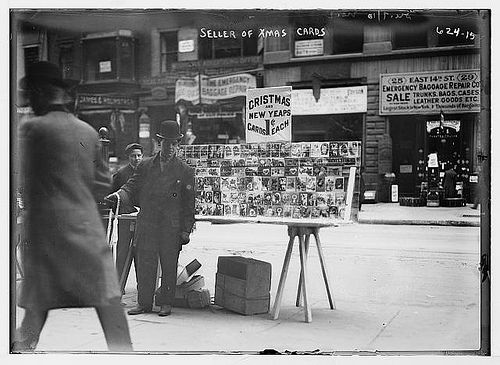
Christmas Card Vendor, New York City, ca. 1908-1917. Bain News Service, Library of Congress Collection
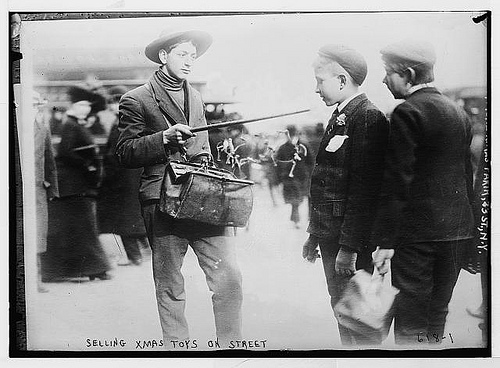
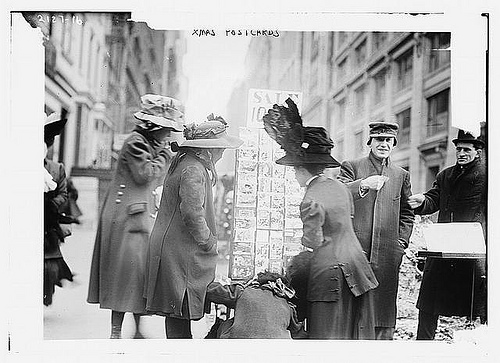
These century-old photos of peddlers hawking holiday cards–one cent each!– teddy bears and ingenious toys on New York City streets, circa 1908-1917, are a window onto Christmases past for street vending. Exchange the clothing and the goods for the 21st century equivalent and they could be on the street today. Or maybe not…
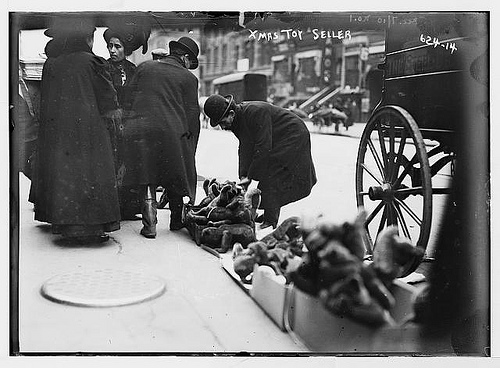
Vendor of Christmas Toys, 6th Ave, ca. 1908-1917. Bain News Service, Library of Congress Collection
According to the Street Vendor Project, a membership-based non-profit creating a grassroots movement for vendors, if you want to sell such items, you may be out of luck. In 1979, the New York City Council created a cap of 853 on the number of merchandise licenses. The waiting list is so long that the Department of Consumer Affairs closed it more than 20 years ago.
An exception is made for veterans who were discharged from the service as disabled and for those selling books, magazines, CDs, and art, which are protected by the First Amendment right to free speech. More than 90% of New York City’s street vendors are immigrants and about 10% of vendors are veterans granted a special license under a New York State Law passed in the 1890s.

Selling Xmas Toys on Street, ca. 1908-1917. Bain News Service, Library of Congress Collection
City regulation of street vending began in 1906, when a Mayoral Commission inquired into the so-called “Push-Cart Evil.” They concluded that the number of pushcart vendors and sidewalk stands should be regulated.
While adding materially to the picturesqueness of the city’s streets and imparting that air of foreign life which is so interesting to the traveler, lending an element of gaiety and charm to the scene which is otherwise lacking, the practical disadvantages from the undue congestion of peddlers in certain localities are so great as to lead to a demand in many quarters for the entire abolition of this industry, if it may be dignified by that term. It is argued, and with much reason, that when the city was smaller and there was no congestion of street traffic, there was no harm in permitting a few persons to earn their livelihood by peddling their wares along the highways.– Report of the Mayor’s Push-Cart Commission, The City of New York
1906
At the time 97% of the vendors were Jewish, Italian and Greek immigrants who had lived in the U.S. from five to ten years. For many, peddling was not their sole occupation, and was often only a temporary way to make a living, as it was in my grandfather’s day, when he and my father had a wagon selling popcorn and 5- and 10-cent lunch.
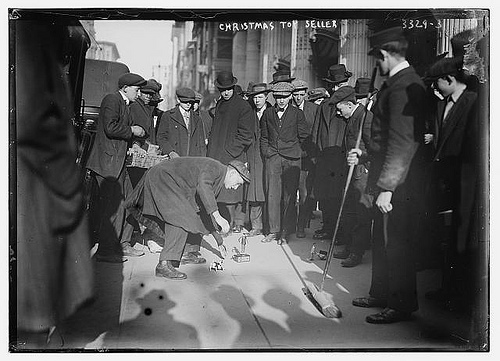
Christmas Toy Seller, New York City, ca. 1908-1917. Bain News Service, Library of Congress Collection
Pitching one’s wares was also strictly regulated according to the Annual Report of the Police Department of the City of New York for 1920.
Peddlers, Hawkers, and Vendors Generally
TIME OF CRYING
6. Section 133. No street peddler, or vendor, shall blow upon or use any horn or other instrument, nor make any noise tending to disturb the peace or quiet of a neighborhood, for the purpose of directing attention to his wares or trade. No peddler shall cry or sell his or her wares, or merchandise, on Sunday, nor after 9 o’clock P. M., nor cry his or her wares before 8 o’clock in the morning of any day except Saturdays, when they will be allowed to cry or sell their wares or merchandise until 11:30 o’clock P.M.
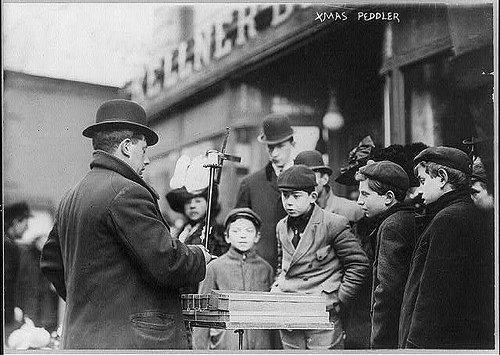
Xmas Peddler, New York City, ca. 1908-1917. Bain News Service, Library of Congress Collection
PLACE OF CRYING
7. No peddler shall be allowed to cry his or her wares within a distance of 250 feet of any school, court house, church or building in which religious services are held, during hours they may be in session: nor at any time within a like distance of any hospital, asylum or other like institution; nor within a distance of 250 feet of any dwelling house or other building, when directed by an occupant thereof not to do so.
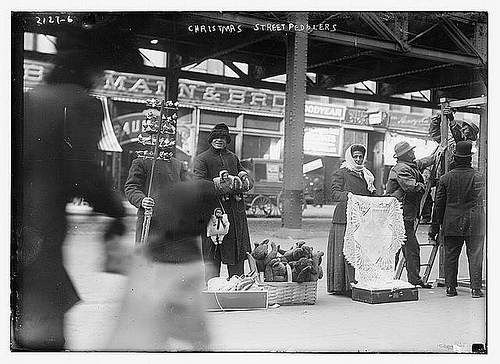
Christmas Street Peddlers. Bain News Service, Library of Congress Collection
“Our economy is changing and work is changing,” writes Braeden Lentz, a staffer at the Street Vendor Project. “Yet street vendors have been creating their own economy, one that is not subject to the whims of corporations, for two centuries.” With more than 1,500 active vendor members, SVP offers programs such as The Pushcart Fund’s small business loans, legal and technical assistance, classes for people thinking of becoming food vendors and the Vendy Awards for the best in the business.

Xmas Postcards, New York City, ca. 1908-1917. Bain News Service, Library of Congress Collection

Related posts on ATZ…
December 13, 2013: Photo Album: Gingerbread Coney Island in City Harvest Extravaganza
December 9, 2013: Photo Album: First Snow of the Season in Coney Island by Bruce Handy
December 24, 2011: Video of the Day: Winter Wonderland for Christmas Eve
December 18, 2011: Playing Santa at the Coney Island Polar Bear Plunge
Read Full Post »




 Amusing the Zillion