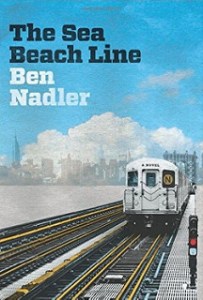
 The MTA’s Sea Beach Line, better known as the N train, now has a fascinating new novel named after it, by Ben Nadler. The Sea Beach Line takes the reader from the Southern Brooklyn neighborhoods of Coney Island, Sheepshead Bay and Brighton Beach to Manhattan’s Washington Square Park and the Upper East Side.
The book’s narrator Izzy Edel has a mystical bent and is well-versed in Jewish texts, both real and imaginary. After getting kicked out of college for hallucinogenic drug use, he travels to New York in search of his estranged father, who is missing and presumed dead. A postcard with a tattooed mermaid and a letter with a return address in Coney Island lead him to his first clues at a private museum run by a business associate of his father’s. A runaway from a Hasidic sect and her relatives, Uzbek gangsters, and his father’s fellow book vendors are among the novel’s intriguing cast of characters.
ATZ asked novelist Ben Nadler, who lives in Brooklyn and teaches writing at City College and the College of New Rochelle, to fill us in on the backstory of The Sea Beach Line in the following Q & A. You can preview the first chapter for free on the publisher’s website.
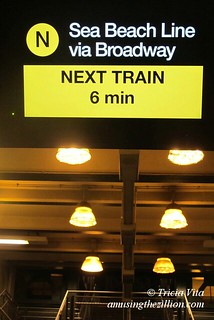
Q: In Stillwell Terminal there’s a sign for the Sea Beach Line which I rarely see anywhere else. What is the history of the line and how did it come to be the title of your novel?
A: The Sea Beach Railway was an independent line which went to Coney Island in the 1800s. It was bought by the BRT, but kept its name as The Sea Beach Line. The BRT was bought by the BMT, which, along with other companies, was in turn bought by the city. Eventually, everything was folded together into the MTA. So, The Sea Beach Line is known today as the MTA’s “N” train. But it retains its full name; in addition to the station signs, the words appear in the illuminated signs on the side of N train cars.
There are some crazy articles from around the turn of the twentieth century in the New York Times archives about independent “inspectors” throwing fare evaders off the Sea Beach Line, on the way to Coney. Some people were seriously assaulted, and at least two women actually died, after being run down on the tracks. These stories inspired me to invent the painting by the artist, R. Galuth, which plays a central role in my novel.
More generally, though, I’m really interested in the layering of history in New York. That’s a lot of what the book is about, digging up these layers of history, experience, and meaning. So referring to a common subway line by its historical name, and elevating into a more a mythic place, is very much in line with what the novel is.

Ben Nadler
A: I live in Midwood, Brooklyn, and have lived here over the entire course of writing the novel. This is sort of the very top edge of Southern Brooklyn, but part of the same world in some ways.
I have been fascinated with Coney Island, specifically, since I was very young. Several of my father’s relatives, including his grandmother, lived in the Amalgamated Warbasse Houses when he was a kid. They were Yiddish-speaking union members who moved down from the Lower East Side when the development opened in the ‘60s. My father always imparted to me that Coney Island is a special place. And because it was the location of the older, immigrant generation of his family, it always seemed more connected to the past than other places for me.
I first moved to New York City in 2002, and would often come down to Coney alone or with friends, to walk on the beach and boardwalk at night. In around 2008 I started dating my girlfriend, Oksana, whom I’m still with. She was born in Russia, but grew up in Coney Island, on West 23rd St. Some of her family still lives there. Oksana further introduced me to the broader Coney Island neighborhood to the west of the amusement area, as well as to Brighton to the east.
The Manhattan material has more of a direct connection to my experiences: I was a bookseller on West 4th Street for a few years. I came to New York to study at the New School in the West Village, and ended up working as a bookseller for the last couple years of college, and for a bit after. I don’t think there is anything from my own biography in the plot or the characters, but the accounts of the bookselling business, and the street culture around the park in the early 2000s, are very much a pastiche of my memories and experiences.
Q: The scenes that flash back to 11-year-old Izzy meeting and bonding with his estranged father as they go crabbing on the pier in Coney and make a meal of the catch are masterful. How did you come up with this chapter?
Thanks. This was actually the very first part of the book that I wrote. Everything grew from there.
Basically, a friend and I were spending a lot of time crabbing and fishing on the pier that summer. It was mainly an excuse to make ourselves get up early, ride our bikes down Ocean Parkway at dawn, and drink on the pier in the morning. So the scene started to come together in my mind over successive weeks, sitting on the pier bench, waiting for the tug on the line. The characters were birthed from the setting, to a degree.
Q: The mix of Jewish mysticism and noirish plot drew me in. Can you talk a little about what inspired that combo?
A: Honestly, this wasn’t a planned combination. These are just things I write about.
That being said, I think there are some natural connections between the two elements. Hasidic tales in Eastern Europe were all about taking complex religious and mystical traditions, and bringing them into narratives that could be accessibly shared amongst common people. And noir/ hardboiled/ pulp novels in America were a way of taking the literary form of the novel, and making it into something accessible (in terms of plots, language, and the actual ownership of books) to a wider, and largely working class, audience. So they fit well together. Especially in the streets of Brooklyn.
More than anything though, we are talking about different forms mystery. The search for what’s hidden.
 Q: Have you written anything else about Coney Island (nonfiction/journalism) or set in Coney Island (fiction)?
A: Yeah, over the years I have done some freelance nonfiction writing about Coney Island for different blogs and publications. My favorite example of this is the article my girlfriend and I wrote about the reconstruction of Steeplechase Pier after Hurricane Sandy.
Several years ago, an editor from Sea Gate tried to start a local Coney Island newspaper. He got a publisher who was supposed to sell ads and fund it, and he hired he me and a photographer to put together some stories. I did a lot of great interviews, and got to meet some awesome people, but then the publisher skipped town, and the paper never got printed.
Coney Island pops up in a lot of my writing. A chapter of my out-of-print first novel, Harvitz, As To War, takes place in Coney Island, in the projects. One of the pieces in a comic book, Line & Hook, which I made with Alyssa Berg and is forthcoming next month from Perfect Wave, is written from the perspective of an old drunk on the Coney Island boardwalk.
Q: You seem very familiar with Coney Island – for example, putting the fictional Galuth Museum on 18th Street, which is one of Coney’s mysterious missing streets. What place in Coney Island, past and/or present, captures your imagination?
A: A missing street is such a great opportunity for a fiction writer. Because it doesn’t exist, I had total freedom to construct my own location. But at the same time, because it’s located between two real places, it was firmly grounded and contextualized in the experiential world.
In Coney Island, like a lot of New York City, the tenements were destroyed in “slum clearance” and replaced with public housing projects. It is debatable if this was the best thing for people or not (or if it could have been a better thing for people if the history of the projects unfolded differently, with more support). In any case, you can’t really talk about life in Coney Island today without talking about life in housing projects. But I am entranced by these disappeared neighborhoods. Throughout the city, there are old neighborhoods buried under NYCHA projects, under expressways, under skyscrapers, under Lincoln Center.
For pure mystery and imagination, though, you can’t beat Dreamland. This was the quintessential Coney Island amusement park, a reified world of fantasy and imagination. It lasted for just seven years before disappearing in flames. When I look at old post card photos of the front gate, with the giant angel statue in the middle, my imagination goes wild.
The Sea Beach Line by Ben Nadler. Fig Tree Books, 2015. Softcover, $15.96.
Related posts on ATZ…
October 25, 2015: Autumn Reading: Novels Starring Circus Mermaids, Coney Island Sideshows, Traveling Shows
December 1, 2014: Autumn Reading: Ward Hall – King of the Sideshow!
November 22, 2014: Autumn Reading: The Brooklyn Theatre Index of Coney Island, Brighton Beach & Manhattan Beach
November 10, 2014: Autumn Reading: The Lost Tribe of Coney Island




 Amusing the Zillion