
Photo showing lack of drainage on concrete section of Boardwalk. Photo courtesy of Coney-Brighton Boardwalk Alliance
ATZ obtained a copy of a letter the Coney-Brighton Boardwalk Alliance sent to members of the City’s Public Design Commission, rebutting the Parks Department’s claims in a recent NY Times article that plastic and concrete is the only viable alternative to wood. The first part of the cover letter is reproduced below. On Tuesday, the grassroots group sent the letter to each commissioner along with a binder of research and photos that will be posted on the group’s soon-to-debut blog and publicized via twitter. Also to be posted is a statement on viable alternatives to tropical hardwoods for decking by Tim Keating of Rainforest Relief that is an addendum to the letter. (Update: The website http://savetheboardwalk.wordpress.com went live on March 5, while an online petition continues to gather signatures. The public hearing at the Design Commission is set for Monday, March 12.)
“The New York Times ran an article that made it seem like it’s just about over, but they didn’t have all the facts,” said CBBA’s Christianna Nelson in a post on Coney Island USA’s Message Board. “The other news outlets have simply been quoting that article. The fact is, the Design Commission has not ruled on the issue and they CANNOT rule without first having a public hearing. We all need to show up at that hearing and make our voices heard! Rob Burstein and I were interviewed on Good Day New York today on Fox, and we tried to correct some of these misconceptions.”

Photo showing concrete section of Boardwalk in Brighton Beach. Photo courtesy of Coney-Brighton Boardwalk Alliance
Do I have to even mention this is a David vs Goliath situation? New York City’s Parks Department has an annual budget of $249 $290.2 million. Coney-Brighton Boardwalk Alliance is made up of local people who volunteer their time. Hearings scheduled by Parks for January 30 and February 21 were abruptly postponed. How inconvenient for citizens who arranged to take time off from work to attend! Meanwhile, the Alliance’s online petition to “Keep the Boards in the Coney Island Boardwalk –No Concrete! and Save the Rainforests” continues to collect signatures, though it would have a lot more if the Times story read round the world had provided a link to it.
ATZ’s takeaway from the Times story on the Boardwalk was that Parks has been lobbying PDC Commissioners and postponing the vote till they’re sure of a win. In the article, Commissioners were described as “persuaded” or “resigned to” the Parks Department’s plan to use plastic wood and a strip of concrete down the middle for emergency vehicles. This so-called compromise plan was in fact voted down by the Community Board last year. It’s too bad the New York Times, which made this compromise plan sound inevitable, removed the word “concrete” from the original headline on the web version of the story when they corrected it to add the word “may.” Is concrete a dirty word?
Here is the first part of the Coney-Brighton Boardwalk Alliance’s letter, which is signed by Rob Burstein, the founder and president of the organization, and Christianna Nelson, the chairwoman.
Dear Commissioner,
Enclosed is a binder with research, letters, and photos we have gathered that together create a compelling argument for maintaining Coney Island’s wood boardwalk. A recent New York Times article reported that, “some commission members said they would reluctantly embrace the synthetic wood-concrete compromise.” Given that the Parks Department seems to have communicated privately with at least some Commission members, we respectfully request the same opportunity. We wish to provide you with information that our experts have compiled that the Parks Department is either unaware of or has willfully ignored, thus denying you the opportunity to benefit from it in your decision-making process. A decision of this magnitude should be based on a complete understanding of all the issues and available options. This is especially true since the Commission’s decision will have profound and far reaching implications for all the citizens of New York City, but most especially for the communities which will be most affected by whatever action the Commission takes.
We are sharing this information with you so that you have adequate time to review it in advance of any hearing, to reflect on its merits and factor it into your decision. Accordingly, we would like to schedule a meeting with you and the other Design Commissioners, at your earliest convenience, to present our research in person and to correct the numerous fallacies in the Parks Department’s arguments as reported in the Times article. Additionally, we would like to invite you on a brief tour of Boardwalk sites, to show you completed work with design elements that are problematical, yet still repeated in the current Parks Department proposal.
To provide you with a brief overview, the Times articles describes three arguments that the Park Department proffers in support of replacing the majority of the boardwalk with either concrete or plastic. None of these arguments, either standing alone or collectively, supports the Parks Department’s proposal.
Claim #1: There is no viable wood. The Parks Department states that they have “investigated every option, from natural woods like Douglas fir and black locust to treated woods like Southern yellow pine. They concluded that such hardwoods were neither durable enough nor, in the case of black locust, abundantly available.”
Reality: This is simply not true. A study commissioned by the Parks Department in 2008 and conducted by the Columbia School of Engineering concluded that black locust wood was the best material to use in rebuilding and repairing the boardwalk. (Tab 1).
Black locust wood is, in fact, readily available in large quantities. (Tab 2). ***For more specific information (suppliers, treatment methods, other possible wood options, etc.), please see the attached Addendum #1 from Tim Keating, Director of Rainforest Relief.
Ocean City, Maryland recently repaired their boardwalk using treated #1 dense southern yellow pine for the decking. Their substructure of concrete footings provides enough support for the passenger trams that run up and down their boardwalk daily, as well as car and fire engine parades. (Tabs 19-21).
Claim #2: Wood is more expensive. The Parks Department contends that concrete and plastic are “cheaper than wood to build and maintain.” Domenic Recchia claims that it costs “more than $1 million a year to maintain the wooden Boardwalk.”
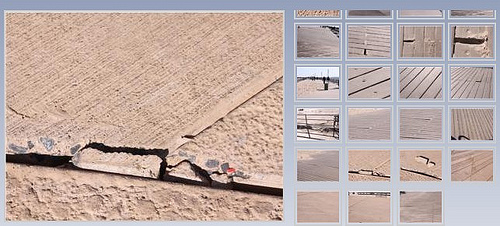
Reality: The Parks Department spent millions of dollars on concrete sections which have already required significant repairs. Numerous unsightly cracks have appeared and, in some places, whole chunks of concrete have crumbled away, both on the decking area and underneath in the substructure. (Tab 22 shows photos of some of this damage). By contrast, in Ocean City, Maryland, City Engineer Terry McGean tested very small sections of various materials for a brief period to determine what was best for long-term use. (Tab 20 contains a photo of these test sections).

Photo showing brand new concrete decking in Brighton Beach already cracked and stained. Photo courtesy of Coney-Brighton Boardwalk Alliance
Concrete and plastic take maintenance, too. In fact, the biggest cost differential between wood and concrete is in the installation, not the maintenance. In Ocean City, McGean determined that over a 50-year period, the cost difference between wood and concrete was $1 million dollars ($16.7 million for all wood and $15.5 for wood with stamped concrete). This amounts to an extra $24,000 per year for wood vs. concrete. (Tabs, 18, 20).
From an aesthetic standpoint, concrete deteriorates much more quickly than wood, and is more difficult to repair, since there is no option of merely replacing one or two faulty boards. The numerous chips, cracks and stains create “an unappealing, patchy look that downgrades the overall appearance of the boardwalk.” (Tabs 10, 11, 17, 22).
The Parks Department ignores the fact that people come from all over the world to see our Boardwalk, bringing tourism dollars to New York. Mr. Benepe states that “economic considerations outweigh the historical importance of the wood.” But wood’s historical significance has real economic value. (Tab 15). People come to Coney Island to experience its history and unique character, not to see a generic concrete and plastic sidewalk. (Tab 23 shows numerous comments to this effect from the over 2,000 tourists and locals who have signed our online petition). Indeed, Ocean City, Maryland changed part of its boardwalk from concrete back to wood in the late 1990’s and experienced significant economic improvement as a direct result. (Tab 16). More recently, in 2011, Ocean City considered creating a concrete lane for vehicles on their boardwalk, similar to what the Parks Department is proposing for Coney Island. (Tab 20). But they decided against this option when the results of their online poll showed overwhelming support for an all-wood boardwalk without any traffic lane. Tourists and locals alike lauded their boardwalk as the city’s “heart and soul.” (Tab 17).
The Parks Department is relying on conflicting assumptions. They claim that the Boardwalk is in enough disrepair to warrant a complete overhaul. Yet they also claim that it costs $1 million per year to maintain it. If they have been spending $1 million per year on maintenance, how is it that the boardwalk is so damaged? And if they have not been doing proper maintenance, how can they possibly know how much that maintenance costs? The fact is that the Parks Department has refused to allocate funds to properly maintain the boardwalk. Instead, they have neglected the boardwalk for many years and now claim that the only solution is to destroy the whole thing and build a new one using borrowed capital funds. It would be more cost-effective to repair the current structure and maintain it properly.
Claim #3: Concrete and plastic are sturdier and just as safe as wood. The Parks Department claims that “a 12-foot concrete section for emergency vehicles” is necessary.
Reality: This argument relies on two unwarranted suppositions. First, the Parks Department premises its claim that heavy vehicles, such as police cars and sanitation trucks, need to use the boardwalk as a roadway. A cursory review of New York City amply demonstrates that police patrols do not necessarily need to take place in heavy vehicles. Lightweight golf cart vehicles, which are used in other New York City venues, should be considered here, as well as bicycles in warmer weather. Similarly, trash collection can be accomplished using smaller vehicles. Certainly, this has been done in other public spaces, such as Central Park. (Tabs 6, 7, 11).
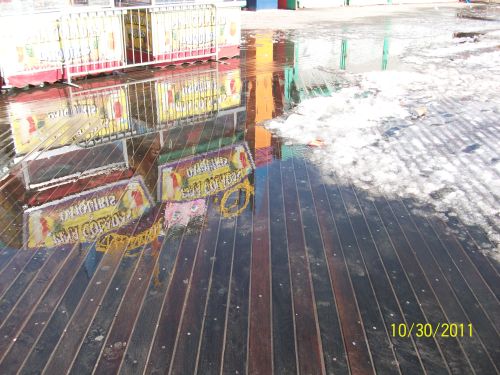
Photo showing lack of drainage on wood over concrete slab section of Boardwalk in Coney Island amusement area. Photo courtesy of Coney-Brighton Boardwalk Alliance
Second, the Parks Department relies on the flawed premise that, even if heavy vehicles were to continue to use the Boardwalk, there is no way to construct a supportive structure utilizing wood. Ocean City Maryland’s boardwalk, which accommodates daily tram traffic for its 8 million annual visitors, demonstrably proves otherwise (According to a November 7, 2011 press release at www.nyc.gov, Coney Island receives approximately 640,000 visitors in the summer season). Ocean City’s boardwalk is able to support this kind of enormous traffic because of its innovative, strong substructure. (Tabs 16, 19-21).
Moreover, the concrete and plastic sections that the Parks Department already installed have created real safety hazards that simply are not present when wood is used. The concrete slabs do not allow for sufficient drainage of water. Consequently sheets of ice build up on the concrete in the winter. (Tab 22 contains a photo showing sheets of ice on the concrete section, but no ice on the wood section). The plastic decking material fares no better. The plastic is slippery year round, especially given the ocean mist. ***For more specific information about the hazards of RPL, please see attached Addendum #1 from Tim Keating, Director of Rainforest Relief.
The Parks Department’s use of concrete slabs as a substructure over which wood is placed also creates safety risks. The lack of drainage inherent in this design causes sand and other debris to build up. The result is damaged wood and loose screws, both of which present hazards to pedestrians and bicyclists. ***For more specific information regarding these design flaws and problematic previous applications, please refer to the attached Addendum #2, which contains email correspondence from Stuart K. Pertz, FAIA, Architect and Urban Designer.
Additionally, the concrete substructure creates a harsh and unforgiving surface for runners, pedestrians, and dancers, who all use the Boardwalk on a daily basis (Tabs 9, 11, 12, 13, 14). Concrete also has been known to concentrate wave energy, increasing the risk of floods. (Tab 8).
If concrete and plastic were the only environmentally responsible, affordable, easily available, sturdy, and safe options for repairing a boardwalk, no city would choose to maintain a wood boardwalk. But many communities across the country have found that wood boardwalks are, in fact, viable and beneficial. For example, Long Beach, NY; Long Branch, NJ; Asbury Park, NJ; Point Pleasant, NJ; Seaside Heights, NJ; Atlantic City, NJ; Ventnor, NJ; Ocean City, NJ; North Wildwood, NJ; Wildwood, NJ; Bethany Beach, DE; Ocean City, MD; Myrtle Beach, SC; Miami Beach, FL; and Santa Monica, CA are some of the municipalities that have come to the reasoned conclusion that a wood boardwalk can and should be maintained.
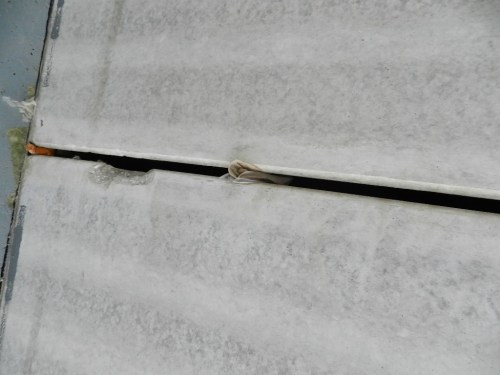
Underneath the Boardwalk near Steeplechase Pier. Photo courtesy of Coney-Brighton Boardwalk Alliance

Related posts on ATZ…
September 8, 2012: October 4: Coney Island’s Endangered Boardwalk to Get its Day in Court
January 24, 2012: Parks Postpones Do-Or-Die Hearing on Coney Concretewalk
January 20, 2012: Jan 30: NYC Design Commission to Meet (Again) on Coney Island Concretewalk
January 5, 2012: New Year, New Push to “Keep the Boards in the Coney Island Boardwalk”
Read Full Post »



 Amusing the Zillion