Feeds:
Posts
Comments

Archive for January, 2012

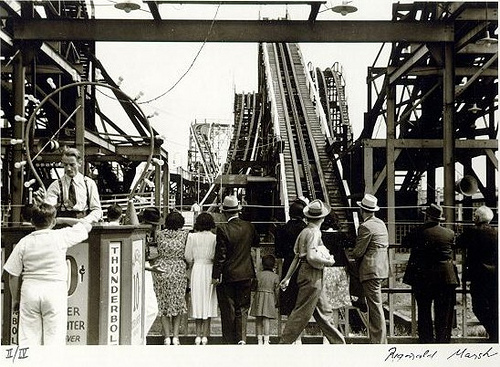
Thunderbolt Roller Coaster from Photographs of New York by Reginald Marsh. ca. 1938-1945, printed 1976. Reginald Marsh. Courtesy AntiquePhotographics.com

Best known for his drawings and paintings of crowds at Coney Island’s beach, artist Reginald Marsh also took photos with a 35mm Leica beginning in 1938. These images from the 1930’s and ’40s by Marsh are from a portfolio of 50 photographs of New York City published in 1977, which is currently offered for sale. The limited edition of 25, plus four artist proof sets, were printed from the original negatives with the provision that the negatives could not be used for any further publication. “The sets are very rare,” photography dealer Jeffrey Kraus of Antique Photographics, told ATZ. “I sold one a number of years ago and this is the second set I am offering.” The portfolio is available for $6500.
Reginald Marsh

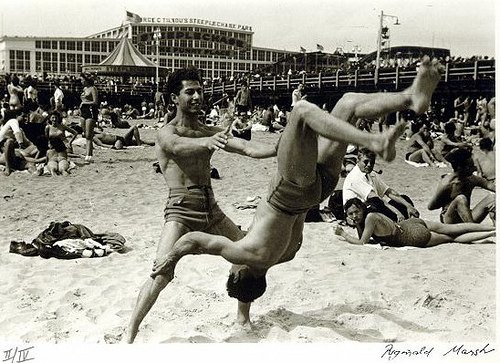
Beach Gymnasts from Photographs of New York by Reginald Marsh. ca. 1938-1945, printed 1976. Reginald Marsh. Courtesy AntiquePhotographics.com

Coney Island was one of Reginald Marsh’s favorite places to sketch and photograph. On a hot summer’s day he’d take the subway from his studio high above Manhattan’s Union Square. “I like to go to Coney Island,” said Marsh, “because of the sea, the open air, and the crowds—crowds of people in all directions, in all positions, without clothing, moving—like the great compositions of Michelangelo and Rubens.”
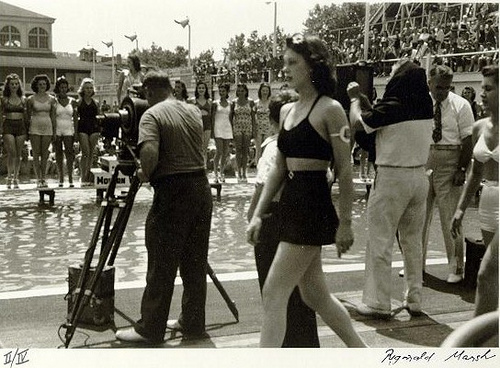
Beauty Contest from Photographs of New York by Reginald Marsh. ca. 1938-1945, printed 1976. Reginald Marsh. Courtesy AntiquePhotographics.com

Marsh was also drawn to the front of the shows, where people stood entranced by the talkers, and the whirl of rides like the carousel and the Virginia Reel, which also attracted onlookers. The Virginia Reel was invented by Henry Elmer Riehl, who named the ride after his daughter, Luna Virginia Riehl. Originally in Luna Park, it later operated at Bowery and West 12th Street as part of Kyrimes Park, where it shared a lot with such now vanished rides as the Gyro Globe, the Looper and the Whip.

Back in the day, there were more independently owned rides and attractions and all had their own distinctively-lettered, open-air ticket booths. The only ride in Coney Island that exists today with its original ticket booth is the Wonder Wheel. Like the Wheel, the ticket booth was built in 1920.
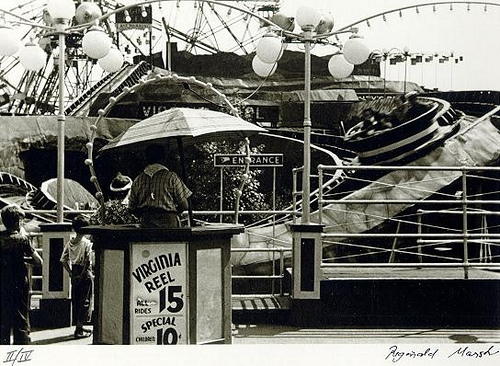
Virginia Reel from Photographs of New York by Reginald Marsh. ca. 1938-1945, printed 1976. Reginald Marsh. Courtesy AntiquePhotographics.com

In an essay published with the portfolio, Norman Sasowsky, who worked as a curator/cataloguer for the Marsh estate, notes that the artist had a pass to Steeplechase Park given to him by park founder and operator George C Tilyou. Steeplechase’s carousel was a favorite subject. “Even though Marsh did not think of himself as a photographer–trying to make a photograph as an end in itself–he produced an exceptional array of photographic images. He selected unerringly the frame for the bit of reality he was about to record,” writes Sasowsky. “Marsh used his camera to photograph other events, such as family gatherings or friends, but his photographs of the places and people he used as themes for his paintings and prints are of special interest because of their intrinsic value and their relationship to his work.”
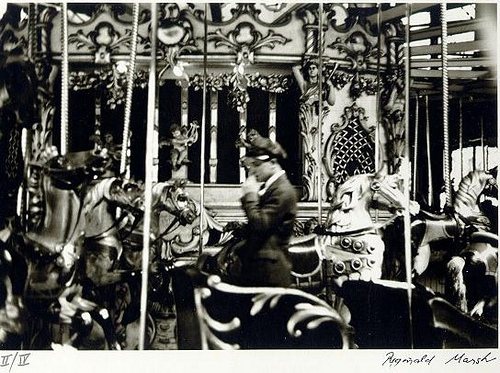
Carousel

Carousel with Attendant from Photographs of New York by Reginald Marsh. ca. 1938-1945, printed 1976. Reginald Marsh. Courtesy AntiquePhotographics.com

Share

Related posts on ATZ…

October 2, 2011: Lucille Fornasieri Gold’s Coney Island Photos from the 1970s

July 13, 2011: Circus Portraits: Photography by Kevin C Downs

March 22, 2011: Rare & Vintage: Souvenir of Frank Bostock’s Coney Island

December 19, 2010: Rare & Vintage: Original Coney Island Motordrome Bike
Read Full Post »

Casinos

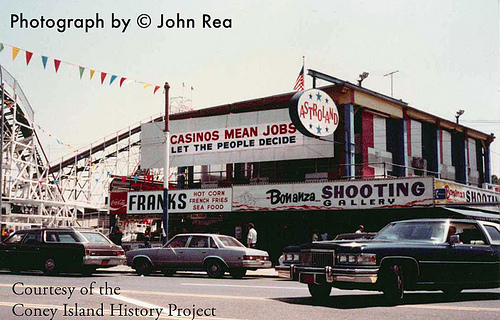
Casinos Mean Jobs Sign at Astroland, 1978. Photo © John Rea, Courtesy of the Coney Island History Project. All Rights Reserved

Last week, when Brooklyn Borough President Marty Markowitz called Coney Island “a natural” for casino gambling, and said it would bring jobs and revenue, he gave voice to what Coney Islanders with long memories have been talking about since Governor Cuomo proposed legalizing casino gambling in New York. It brings back memories of the late 1970s when “Casinos Mean Jobs- Let the People Decide” was the slogan of a group of Coney businessmen who lobbied Albany. Will the casino gold rush of that era, which finally ended when Governor Carey nixed the idea of a referendum, replay in Coney Island and set off another wave of real estate speculation?

A chapter in Charles Denson’s book Coney Island: Lost and Found vividly documents the “casino fever” that seized Coney after casino gambling was legalized in Atlantic City in 1976 and the New York State Legislature began studying the idea. A billboard saying “Welcome to Coney Island, The Perfect Resort for Casino Gambling” was put up by a local business group writes Denson, who worried that casino gambling would wipe out the amusement area and wouldn’t benefit the neighborhood. He notes that “for a brief period during 1979, the asking price for property on the Boardwalk rose from $3 to $100 per square foot.” Interviews with Horace Bullard, whose Shore Theater was said to have caught Frank Sinatra’s eye, as well as with Astroland owner Jerry Albert and realtor Charles Tesoro portray the “Casinos for Coney” mania that prevailed during a four-year period.

“It was crazy,” Tesoro told Denson. “Limousines would pull up with guys coming up to the office from Las Vegas, in silk suits, saying, ‘sell to us now, get us some property, we wanna get in!’ It was like a crazy house, like the gold rush…They’d sit at my desk and say, ‘Waddaya got? We want options on everything you got. Everything!’ They wanted options because if gambling didn’t go through, they’re out. But if gambling went through, they’d pay triple the asking price for the property.”

One of the reasons gambling didn’t go through was behind-the-scenes lobbying of politicians by the Trumps, who were already involved in Atlantic City, Tesoro and others say in Denson’s book.

Map

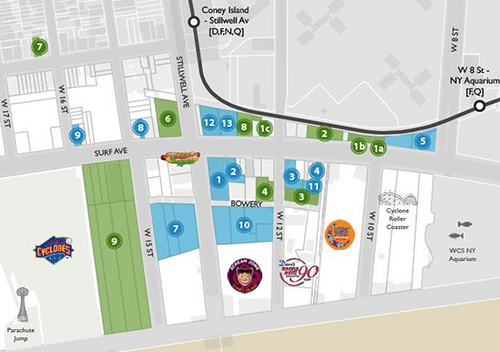
Detail of the CIDC's Coney Island Retail Opportunities Map. Fall 2011. Green = Property for Sale, Blue = Property for Lease

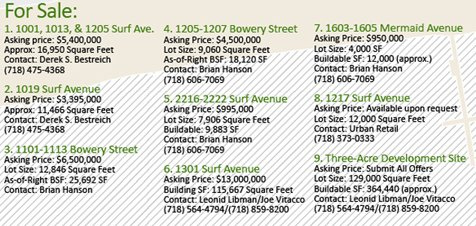
For Sale

Coney Island for Sale: Detail of the CIDC's Coney Island Retail Opportunities Map

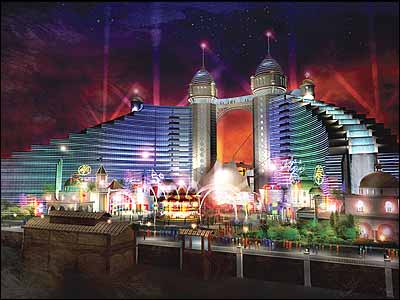
When we first read that Governor Cuomo proposed legalizing casino gambling in New York and Mayor Bloomberg said as long as New York City shares in the revenue, we bet Joe Sitt began dusting off his Vegas-y renderings for the south side of Surf in anticipation. And we imagined that the mostly vacant, fantastically high-priced properties for sale or lease in Coney Island would sit empty for another couple of years, until the referendum on casino gambling could be put to a vote. That won’t happen until November 2013 at the earliest.

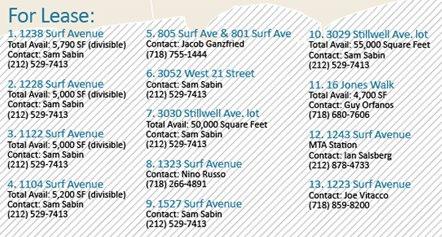
Horace Bullard still owns the Shore Theater, which currently has an asking price of $13 million, and his Thunderbolt parcel, a three-acre development site next to the Cyclones stadium, is up for grabs too. On the north side of Surf, there are the infamous furniture stores in buildings with price tags of $5.4 million and $3.39 million. These sites are among the 24 privately owned properties for sale or lease on the CIDC’s map of Coney Island Retail Opportunities Fall 2011, now called Coney Island Property Opportunities Winter 2011-2012. Will the map morph into Coney Island Casino Opportunities in 2013?

Coney Island Property Map

Coney Island for Lease: Detail of the CIDC's Coney Island Retail Opportunities Map, Fall 2011

The Washington Baths property, which Bullard acquired during the casino gold rush and later sold to Joe Sitt, who in turn sold it to Taconic Investment Partners, which got it rezoned for high-rise condos, would make a dandy casino complex. The 5.5 blocks of vacant land is just west of MCU Park. Blackjack and Baccarat on the Beach? Taconic also has a 99-year lease on the landmarked terracotta palace on the Boardwalk that was once the Childs Restaurant.

The monkey wrench in the plan for a Coney casino is a possible demand by Genting, which already operates a racino at Aqueduct, to ask the state for exclusive rights to casino operations in New York City. However, Governor Cuomo’s spokesman told the Post, “There’s no agreement on exclusivity.”

The Associated Press reports Malaysia-based Genting spent more than $774,000 on New York lobbying in the first 10 months of 2011, or 10 times its total for 2010. Their lobbyist is SKDKnickerbocker, the same firm that represents Thor Equities, Mayor Bloomberg, and other high-powered clients. Coney Island has already been impacted, and not in a positive way, by Genting’s venture at Aqueduct. The displaced Aqueduct flea market vendors moved to Thor Equities Stillwell Avenue property last summer. Their dismal debut was billed as a “festival” because a flea market is not a permitted use in Coney Island’s amusement zone.

September 2005: Thor Equities rendering in NY Magazine's The Incredibly Bold, Audaciously Cheesy, Jaw-Droppingly Vegasified, Billion-Dollar Glam-Rock Makeover of Coney Island

Share

Related posts on ATZ…

December 27, 2011: Amusing the Zillion’s Top 10 Coney Island News Stories of 2011

December 7, 2011: Jones Walk’s “Miss Coney Island” Shimmies Over to 12th St

November 15, 2011: Coney Island 2012: What’s New on the Boardwalk

May 16, 2011: Thor’s Coney Island: Aqueduct Flea Vendors Make Dismal Debut

Read Full Post »

Time travel back to Coney Island at Night in 1905 and see a panoramic view of the magical lights of Luna Park, Dreamland and Steeplechase. This early time exposure was made by pioneering filmmaker Edwin S. Porter, whose use of panning and the first after-dark photography can be seen in films of the 1901 Pan-Am Exposition in Buffalo. The long, sweeping view of Coney Island’s three great amusement parks ends with the camera panning up and down the Dreamland Tower.

According to Charles Musser’s Before the Nickelodeon: Edwin S. Porter and the Edison Manufacturing Company, Edison acquired “the exclusive privilege” for the 1905 season at Dreamland. Other subjects made by Porter under this contract are Hippodrome Races, Dreamland, Coney Island (June 1905), Mystic Shriners’ Day, Dreamland, Coney Island (July 1905), June’s Birthday Party (July 1905), and Boarding School Girls. In this version of the film, the young ladies of Miss Knapp’s Select School go on an outing to Coney Island where they pass through Dreamland’s Creation gate, frolic in the surf and ride Steeplechase’s camels and mechanical Horse Race.

Share

Related posts on ATZ…

August 16, 2011: Video of the Day: “IT Girl” Clara Bow in Coney Island

January 15, 2011: ATZ Saturday Matinee: Shorty at Coney Island

December 16, 2010: Blast from the Past: LFO’s Summer Girls Music Video

September 27, 2010: Video: The Museum of Wax by Charles Ludlam

Read Full Post »

« Newer Posts - Older Posts »