Feeds:
Posts
Comments

Archive for the ‘history’ Category

oldest

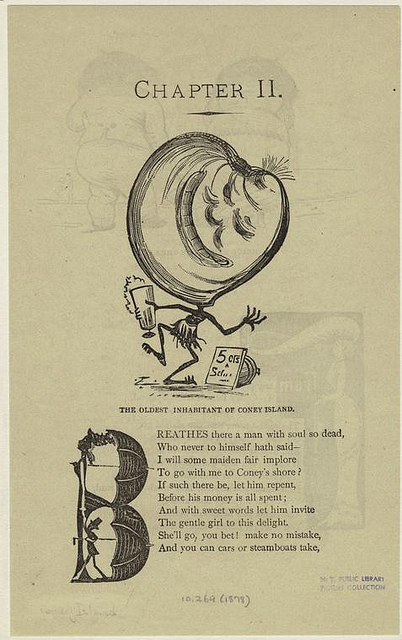
The Oldest Inhabitant of Coney Island from The History of Coney Island, 1878. Picture Collection of the New York Public Library

Coney Island’s Dancing Clams are older than the Switchback, the world’s first roller coaster (1884), and George C. Tilyou’s Steeplechase Park (1897). In fact, the frolicking mollusks are Coney’s oldest inhabitants, ATZ learned from a droll history of the seaside resort published in 1878. “The History of Coney Island from its first discovery in 4, 11, 44, down to last night, in rhyme” is a 47-page book with whimsical sketches of the summer scene from Coney’s western end at Norton’s Point to Brighton and Manhattan Beach. We also discovered that this rare volume was digitized by the Library of Congress and can be read online or downloaded to your Kindle.
chowder party

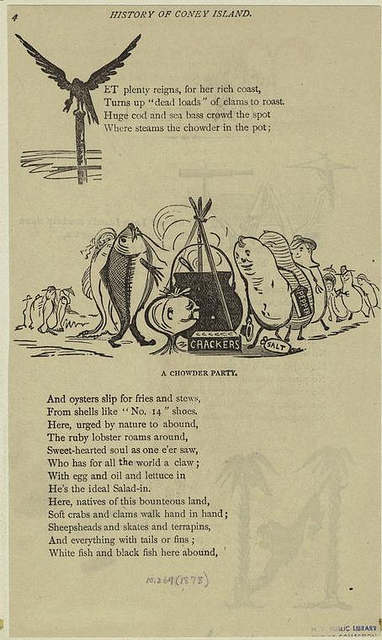
A Chowder Party: Vegetables and fish gathering around a pot of chowder from The History of Coney Island,1878. Picture Collection of the New York Public Library

Written and illustrated by I.F. Eaton, the book was “adapted for all children under age 85, with notes by the editor (promissory ones), with maps and sketches in water color, drawings of bier, and many dry cuts.” There are a great many humorous sketches of beach-goers, including bathing beauties in Victorian dress and a mermaid startling a man digging for clams. It’s interesting to see that Coney’s Dancing Clams were not yet wearing top hats and trousers in 1878.

Last month, ATZ posted Lindsay Wengler’s photos documenting Gyro Corner Clam Bar’s hand-painted signs of top-hatted clam waiters serving clams on the half shell. Reader Beth Greenberg posted the comment “That’s one classy clam: look at his top hat and white gloves. That’s Coney Island!” Indeed, it is. Feltman’s Restaurant, where the hot dog was invented, had a famous ad in the 1900s called “The Epicure’s Parade” featuring both a top-hatted clam and a hot dog, as well as a strolling lobster, corn on the cob and mug of beer. Gregory & Paul’s, now Paul’s Daughter, has their own quirky version painted by Catherine Gavalas about 20 years ago, but my fave is their top-hatted Mr. Shrimp. Artist Richard Eagan, the co-founder of the Coney Island Hysterical Society, paid homage to the Feltman’s original with an architectural portrait of polychromed canvas and wood in 1997 and recently completed a limited handmade edition of ten.

In “The History of Coney Island,” the rhymes are as delightful as the drawings:

The hard-shell crab goes sideling by,
With murder in his little eye.
All sorts and sizes here you view,
Of those you eat and that eat you;
And you can see, in this strange spot.
How fish look ere they go to pot.

Prices were very reasonable in Coney Island back in the day: Tilyou’s Bathing Establishment, Bathing Suit and Clam Chowder, 25 cents. Bathing suit without Chowder, 15 cents. Donkey ride on the Beach, 10 cents. Clams, 5 cents. “The History of Coney Island,” 20 cents.
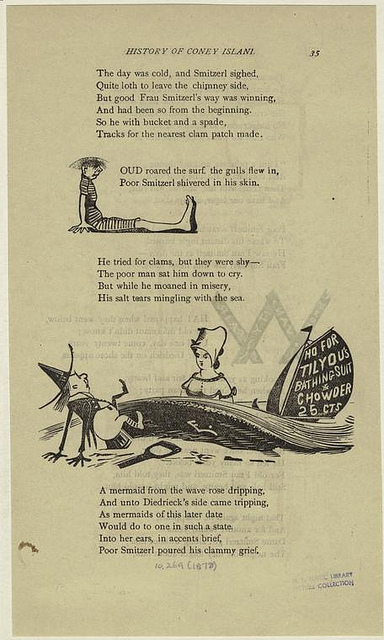
mermaid

Mermaid startling man digging for clams, Coney Island, N.Y. from The History of Coney Island,1878. Picture Collection of the New York Public Library

Share

Related posts on ATZ…

November 3, 2011: Scoop: Randazzo’s Clam Bar Eyeing Coney Island Boardwalk

October 14, 2011: Photo of the Day: Vernacular Signage by Lindsay Wengler

June 19, 2011: Coney Island Summer Reading: The Wonder City

December 8, 2010: Children’s Book Tells Coney Island Carousel Carver’s Story
Read Full Post »

It seems unbelievable, but in 1954, Murray Handwerker of Nathan’s Famous leased an embalmed whale and put it on display next to his Coney Island eatery to attract customers. The seventy-ton, seventy-five foot finback was on show for two months when a heat wave struck and “A Whale in Bad Odor” began driving away customers, according to news reports at the time. Neighboring business owners called the Health Department, which issued summonses for maintaining a nuisance.  It ended up with Handwerker having to pay people to cut up the whale and tow it out to sea.

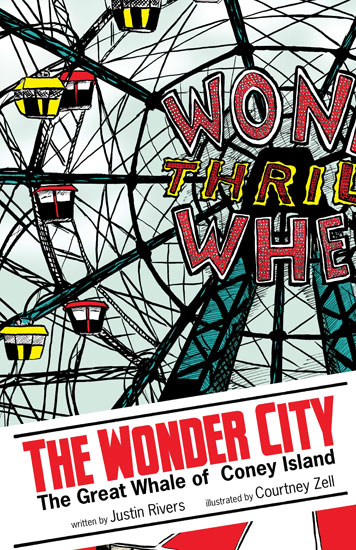
This odd tidbit of Coney Island history was one of the inspirations for “The Wonder City,” an ambitious new graphic novel by Justin Rivers and Courtney Zell that re-imagines the history of New York City starting with Peter Minuit’s purchase of Manhattan. Subtitled “The Great Whale of Coney Island,” the first volume in a planned six-volume series is a captivating mix of history and mythology. “Where does myth end and history begin? What if there was no difference between the two?” asks Rivers, a playwright and educator whose literary influences include Herman Melville’s Moby Dick and Joseph Campbell’s The Hero with a Thousand Faces.

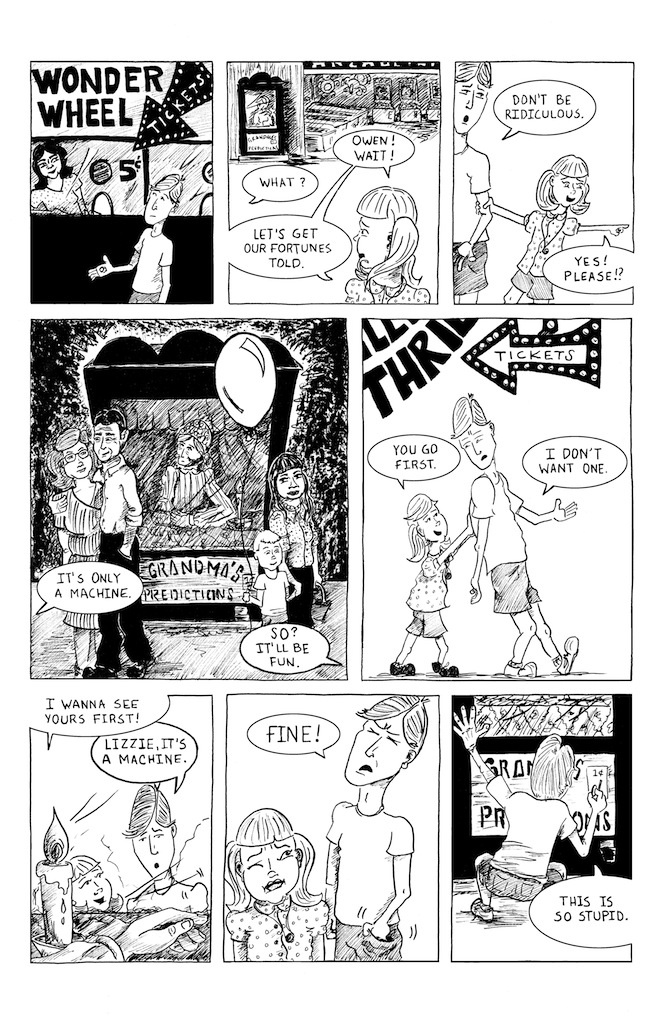
Set in New York City in 1942, the story begins with the delightfully named and drawn “gumshoe” Velma Graydon turning up at the Brooklyn home of the Tulip family. She is ready to spend a large sum to acquire the Parelzaad, a centuries-old charm that six-year-old Lizzie Tulip nonchalantly wears around her neck. Velma is told the heirloom was a gift from the girl’s Dutch grandmother and is not for sale.

But Velma is persistent and unable to let the sought-after charm out of her sight. The next day, she follows Lizzie and her brother Owen on an outing to Coney Island. The Wonder Wheel, which graces the cover of the book, and Grandma’s Predictions, the fortunetelling machine under the Wheel, play a part in the story, along with a dead whale on display as a sideshow attraction and a live whale whose appearance causes havoc in Coney Island.

Courtney Zell’s drawings have a quirky edge and convey emotion and intrigue. As the story unfolds and the mystery deepens, we learn that Velma belongs to a group called The Light Keepers who have long searched for the Parelzaad.  Velma’s research has uncovered documents that trace the charm’s origin to 17th century New Amsterdam. “My father said the charm brought prosperity to his crop,” wrote a resident of the Dutch colony in 1661. “It is our hope that you take it and bring prosperity back to our great city, the symbol of our worldly triumphs and a testament to our survival in the wilderness.”

ATZ first learned about “The Wonder City” last year via the website Kickstarter, where Rivers and Zell posted snippets of the novel-in-progress that piqued our curiosity. “The advice we’ve received from comic publishers is that the economy is bad for new comic book projects right now,” they wrote. “And the best way to get our book noticed is to self publish and get the book out there ourselves. And we’re determined to do it!” The project was successfully funded to the tune of $5518 by 62 backers, who received hand-pulled prints, signed copies of the book and the chance to be drawn into the comic as thank-yous.

The finished book was self-published this month and is on sale for $10 on the Wonder City website, etsy and Amazon.  A book release party and comic book creators meet-up is set for Wednesday, June 29, at 7 pm, at The Bell House, 149 7th Street in the Gowanus area of Park Slope, Brooklyn.

Share

Related posts on ATZ…

June 14, 2011: Coney Island Summer Reading: Dreamland Social Club

January 8, 2011: Boardwalk: Photos by Meredith Caliento, Spoken Word by Michael Schwartz

December 8, 2010: Children’s Book Tells Coney Island Carousel Carver’s Story
September 27, 2009: Coney Island 1969 by Edwin Torres: Fave Poem from Parachute Festival

Read Full Post »

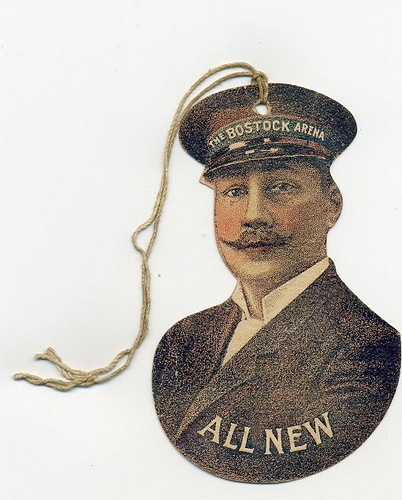
Die Cut Tag from Coney Island's Bostock Arena in Dreamland circa 1904. Courtesy of eBay Seller monsonantiques

We’ve been too busy to blog the past few days, much less browse on eBay. Luckily we found out about the auction of this century-old souvenir of Coney Island’s Bostock Arena via the blog ephemera. The circa 1904 tag depicts famed animal trainer and menagerist Frank C Bostock, whose show was a featured attraction at Coney Island’s Dreamland Park. The reverse side of the tag trumpets the 25-cent show as “Positively the Most Wonderful Wild Animal Exhibition in the World” and notes that “All Bostock’s Patrons Enter Dreamland Free.”

Seller monsonantiques has this rare item up for bid on eBay, where four bidders are vying for it in an auction that ends on Wednesday, March 23rd. The high bid is currently over $150, but that’s peanuts. We’ve seen tickets and advertising tags for Coney’s early rides and attractions sell for several hundred dollars. Good luck to everyone who plans to jump in!

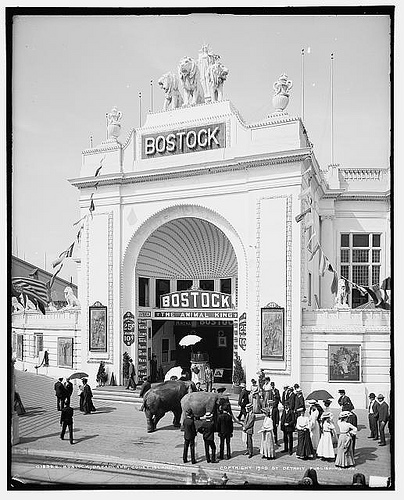
Bostock was a third-generation showman who came to New York from his native England in 1893. He and his partners the Ferari Brothers first set up their carnival on Flatbush Avenue in Brooklyn and then moved to Coney Island. The show featured animal acts, sideshow curiosities, concession games, and such early amusement rides as an English gondola and a carousel.

According to the University of Sheffield’s National Fairground Archive, “The elaborate carved fronts of the wild animal shows Frank Bostock brought from England, some of them made by Burton-upon-Trent company Orton and Spooner, served as the prototype for wagon-mounted show fronts on American carnivals for the next half century.” Since the company toured New England in 1896, historians credit Bostock and his partners with introducing the traveling carnival concept to America. As a former carny kid, this aspect of Bostock’s career holds greater interest for me than his exploits as the best-known lion tamer of his day or his many narrow escapes from death.

If you’d like to read an engaging biographical essay, we recommend “Frank C. Bostock – The Animal King of Abney Park Cemetery.” Bostock died of the flu in England in 1912, more than a year after the fire that destroyed Coney Island’s Dreamland Park. His tomb at Stoke Newington in London is a magnificent marble lion.

UPDATE March 24, 2011:

The tag sold for $386.99 with the winning bid placed in the last few seconds of the auction!

Bostock Arena, Dreamland, Coney Island, N.Y. circa 1905. Library of Congress

Share

Related posts on ATZ…

March 9, 2011: Inexhaustible Cows & Bottomless Cups of Chocolate Milk

January 24, 2011: Artifact of the Day: Souvenir of Henderson’s Restaurant

December 19, 2010: Rare & Vintage: Original Coney Island Motordrome Bike

November 16, 2009: Rare & Vintage: Coney Island Sideshow Banner by Dan Casola

Read Full Post »

« Newer Posts - Older Posts »