Feeds:
Posts
Comments

Archive for the ‘history’ Category

Thunderbolt Roller Coaster

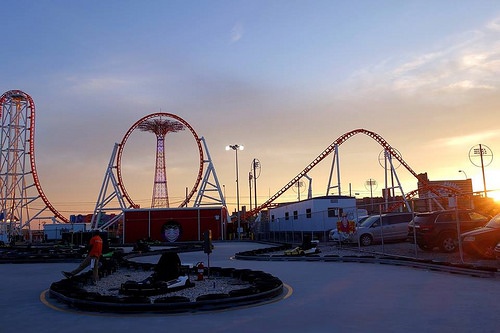
Parachute Jump framed by the Thunderbolt’s Vertical Loop, Luna Park, Coney Island. May 17, 2014. Photo © Jim McDonnell

Weekend visitors to Coney Island were wowed by the sight of Zamperla’s Thunderbolt roller coaster under construction on West 15th Street. Set to open on Memorial Day, which is just one week away, the new $10 million dollar ride’s track rolls, loops, turns and dives from the Boardwalk to Surf Avenue and back again. Photographer Jim McDonnell, who has been documenting the work in progress since Day 1, has captured the sculptural elegance of the coaster. The Thunderbolt has already made its mark on Coney Island’s skyline. Seen from a certain vantage point, the landmark Parachute Jump–Brooklyn’s Eiffel Tower– is framed by the Loop in a shot that is destined to become a favorite of People’s Playground photographers and a Coney classic.
Thunderbolt Loop Completed

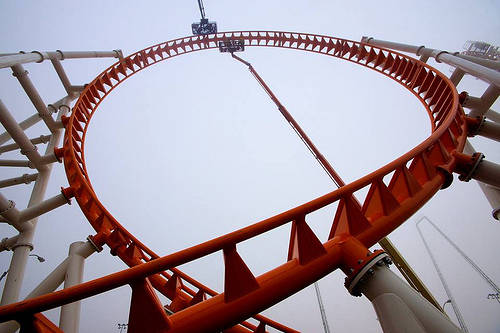
Loop on Luna Park’s new Thunderbolt Roller Coaster Completed, May 15, 2014. Photo © Jim McDonnell

On Thursday, the Thunderbolt’s 100-foot Loop was completed. It was a stunning moment because it’s the first coaster with a vertical loop in Coney Island since the 1901-1910 Loop the Loop, which stood on the corner of West 10th Street where the Cyclone is today. Edwin Prescott’s ride was one of the first to charge admission just to watch. A sign warned “Beware of Pickpockets!” and another said “STRAP YOURSELVES.” The ride’s motto, printed on its tickets, was “Heels up, Heads down!” But the Loop the Loop’s low capacity of four passengers per 10 cent ride was not enough to turn a profit. The Thunderbolt will cost $10 or 10 Luna Park credits to ride. If you’re not brave enough to give it a go, it will of course be free to watch.
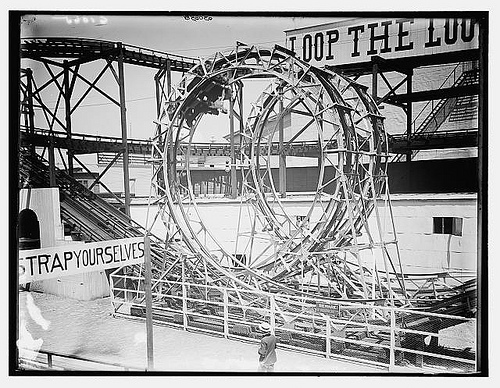
Loop the Loop

Edwin Prescott’s Loop the Loop, Coney Island, 1901-1901. Library of Congress

As previously noted (“High Hopes for Coney Island’s New Thunderbolt Coaster,” ATZ, March 10, 2014), Coney Island has been home to dozens of roller coasters since the Switchback Railway debuted in 1884 but it’s been a long 87 years since one was custom built for Coney — the Cyclone in 1927. The new ride is named in honor of the 1925 Thunderbolt, which occupied an adjacent lot on the same block until it was controversially and illegally demolished in 2000 on the orders of Mayor Giuliani.

The Thunderbolt is the third Zamperla coaster in Luna Park to be named after Coney Island attractions of the past. In 2010, their Wild Mouse-style spinning coaster was rechristened “The Tickler” in honor of an innovative 1906 thrill ride in the original Luna Park, after which the park is named. The next year, a Pony Express-themed Motocoaster in Scream Zone was dubbed the Steeplechase Coaster, after Steeplechase Park’s signature horse race ride.
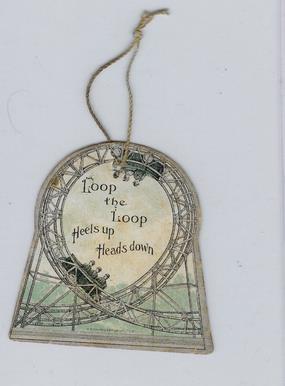
Loop the Loop Ticket

Loop the Loop Ticket, Coney Island, early 1900s. Via eBay seller childhoodthings

UPDATE May 20, 2014

UPDATE May 30, 2014

Watch this video from last evening, when the Thunderbolt went for its 1st first test run.

UPDATE June 15, 2014

The Thunderbolt had its grand opening on Saturday! Here’s the official POV video released by Luna Park

Related posts on ATZ…

March 10, 2014: High Hopes for Coney Island’s New Thunderbolt Coaster

February 23, 2014: Sunday Matinee: Under the Roller Coaster (2005)

September 22, 2012: Saturday Matinee: Coney Island’s Mite Mouse Coaster (1992)

April 21, 2012: Saturday Matinee: A Switchback Railway (1898)

Read Full Post »

This week, British Pathé announced the release of more than 85,000 newsreels from its archives to the public via YouTube. Among the films dating from the early 20th century though the 1970s are several documenting Coney Island. “Let’s Go Coney! Island” (1932) was shot inside Steeplechase Park’s Pavilion of Fun and provides a glimpse of patrons riding the Hoopla, Human Pool Table and Panama Slide. At Luna Park, Victor Zacchini, “The Human Cannonball,” is seen being shot from a cannon across the park’s lagoon as part of the season’s outdoor show.

Other newsreels show riders on the Witching Waves (1919) and the residents of New York Aquarium eating a “Whale Of A Lunch” (1964). (Update: We removed one of the films, Dizzy-Dive Land (1932) which is mis-ID’d as a Coney Island coaster but turns out to be Rye Playland’s Aeroplane (1923-1957), according to American Coaster Enthusiasts co-founder and historian Richard Munch.)

While the British Pathé archive is available online via their own website, going public on YouTube allows viewers to comment, share and embed the historic videos.

“The archive contains unique footage from both World Wars, the Titanic, boxing legend Muhammed Ali and more,” said British Pathé and Mediakraft Networks in a press release. “On top of this startling content, the material also paints vivid pictures of almost forgotten lifestyles, peculiar technical inventions and everyday life that British Pathé presented in newsreels, cinemagazines, and documentaries from 1910 until 1976.”

In “Do You Reverse” (1928), couples slide down a water chute together into Steeplechase Pool. Camera trickery is used to show this in reverse. Divers are also seen jumping out of the water and back onto boards.

Dorothy de Mar wins the title of Miss Venus from hundreds of other bathing beauties at Steeplechase Park in “Is She Your Choice?” (1931).

Share

Related posts on ATZ…

April 21, 2012: Saturday Matinee: A Switchback Railway (1898)
January 8, 2012: Video of the Day: Coney Island at Night by Edwin S. Porter

August 16, 2011: Video of the Day: “IT Girl” Clara Bow in Coney Island

January 15, 2011: ATZ Saturday Matinee: Shorty at Coney Island

Read Full Post »

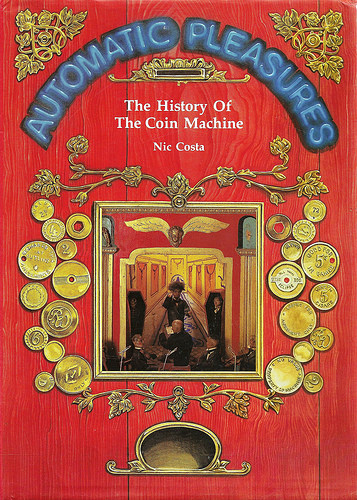
Automatic Pleasures by Nic Costa

Nic Costa’s classic Automatic Pleasures: The History of the Coin Op Machine is once again in print and as relevant as ever, considering the resurgence of pinball in bars and the popularity of a new Cupcake ATM on Lexington Avenue that had a line of people 12 to 15 deep on opening day. There’s also the nearly 10,000 slot machines at New York’s Aqueduct and Yonkers racetracks, a harbinger of many more to come with the legalization of casinos in New York State.

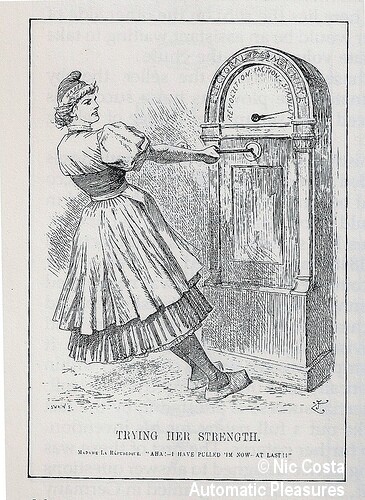
Gambling machines, the one armed bandit, penny arcades, fortunetelling machines, strength testers, shooting games, viewers, and vending and service machines are among the automatic entertainments covered in the book, which is illustrated with both black & white and color photos.

Did you know the first-ever vending machine was a coin-operated holy water dispenser invented by Hero of Alexandria nearly 2000 years ago? Costa writes that it wasn’t until the development of markets and a society based on paid labor that devices saving time were valued and produced in number.

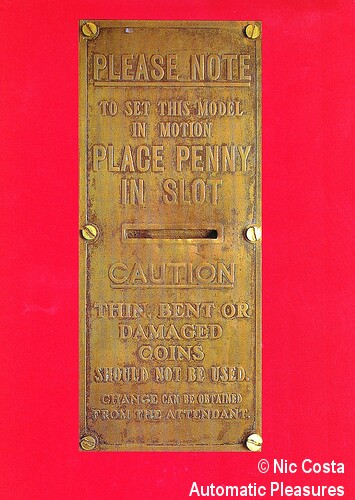
The first coin freed patent was in 1857, for “A Self-Acting Machine for the Delivery of Postage and Receipt Stamps.” A penny inserted would automatically feed out a stamp from a roll. By the mid-1890s more than 1,000 patent applications for coin freed machines had been received by the U.K. Patent Office. Tellingly, many of the early machines could be used either as fortune tellers or games of chance. Games with automatic payouts of a cigar, a card or a token became increasingly popular on both sides of the Atlantic in the 1890s.

Automatic Pleasures by Nic Costa

In the U.K. in the first years of the 20th century, there was a spate of prosecutions against businesses, including saloons and shops, which had the automatic machines. The intent was to suppress “public corruption” and “juvenile depravity.” The enforcement of anti-gambling laws resulted in European manufacturers having to concentrate on games of skill with a low pay-out, which led to the later American domination of the world market.

Automatic Pleasures is enlivened by numerous excerpts from firsthand accounts of the era. Herbert Mills of Chicago’s Mills Novelty Company, once the world’s leading manufacturer of coin operated machines, writes about the Automatic Vaudeville or Penny Arcade business in the early 20th century:

The Penny Arcade has become a permanent institution as much as the theater, the opera, the circus, the concert, the lecture or the gymnasium, for it combines in a modified form of all of these and because it makes such universal appeal, particularly to the poorer classes, it is destined to grow constantly in popularity and size. Only about 10 per cent of the total population have an income of more than $1,200.00 per year, and therefore, the percentage of those who can afford a dollar for a concert ticket or two dollars for a theater ticket is very small. But everyone can patronize the Penny Vaudeville and afford ten cents for half an hours entertainment.

Automatic Pleasures: The History of The Coin Machine by Nic Costa, D’Aleman Publishing, 2013. Paperback, $32.42

Automatic Pleasures by Nic Costa

Related posts on ATZ…

February 5, 2014: National Pinball Museum Founder’s Vintage Games Up for Auction

November 15, 2013: Modern Pinball NYC Opens with New Arcade Business Model

May 7, 2013: Video of the Day: Restoration of Grandma’s Predictions

March 9, 2011: Inexhaustible Cows & Bottomless Cups of Chocolate Milk

Read Full Post »

« Newer Posts - Older Posts »