Feeds:
Posts
Comments

Posts Tagged ‘William F Mangels’

Whip Car

Mackie 'Rides' the Whip Car at the Coney Island History Project. May 22, 2010. Photo © Coney Island History Project via flickr

This Mangels’ Fairy Whip car is one of our favorite artifacts in the Coney Island History Project’s exhibition center. It was manufactured circa 1920 at William F. Mangels Factory on 8th Street in Coney Island, which is now the Department of Motor Vehicles Building. Mangels, who was the inventor of such early 20th century thrill rides as the Whip and the Tickler, is one of the amusement industry pioneers honored in the Coney Island Hall of Fame.

But if you want to ride the Whip, you’ll have to take a trip to Rye Playland, Knoebels, Kennywood, Trimper’s or any one of the other parks or carnivals listed on ATZ’s Whip Census. This video pays tribute to Mangels, who was born on February 1, 1867, and shows the Whip in action at Knoebels.

Last February we marked the birthday of William F Mangels with a pictorial tribute to his shooting gallery targets. This year we’re proclaiming Bring Back the Whip! It’s a shame that Coney Island, where this classic ride was invented, doesn’t have an operating Whip. Patented by Mangels in 1914, the Whip was one of the first and most popular thrill rides. Old timers tell us there used to be quite a few Whips as well as quite a few carousels and roller coasters in good ol’ Coney Island. Wouldn’t it be fitting to have a Mangels Whip installed in Steeplechase Plaza next to Mangels’ B & B Carousell?

Painted Buckets

Painted Buckets: Scene at Trimpers: The Whip - one of the antique mini rides for the little kids. March 27, 2010. Photo © OC Always via flickr

A couple of years ago we started the Whip Census with the help of our friends on Matt’s Carnival Warehouse forum. We were surprised and pleased to find so many Whips out there! As you’ll see from the list, which we believe is far from complete,the ride is still very popular. And it’s nice to know there are still some traveling ones since the Whip is considered the first portable thrill ride. If you know about additional locations, including rides in storage, please comment below or email hello[at]triciavita[dot]com. Perhaps one of these Whips can be relocated to Coney Island in the future!

Parks

Americana/LeSourdsville Lake Park, Monroe, OH. 8-car Whip added in 1941. Park has been closed since 2002.

Beech Bend Park, Bowling Green KY,  Kiddie Whip bought at Guntown Mt sale, originally from Beech Bend and returned home.

Bushkill Park, Easton, PA. Park is currently closed

Camden Park, Huntington, WV, 8-car model

Canobie Lake Park, Salem, NH, 8-car oval Kiddie Whip

Cedar Point, Sandusky OH, Kiddie Roto Whip

Dorney Park, Allentown, PA, 12-car model

Hillcrest Park, Wilmington, IL, Roto Whip. Park closed and ride was sold at auction in 2003.

Idlewild Park, Ligonier, PA. 12-car Whip added in 1930s. It now has fiberglass cars.

Keansburg Amusement Park, NJ, Roto Whip

Kennywood Park, West Mifflin, PA, 1918: The Whip is added. 1923: Kiddie Whip is among the first four rides in Kiddieland. 1926: The original 12-car Whip is replaced by a new 16-car model. 1975: Kiddie Whip is destroyed in Dance Hall (Ghost Ship) fire. A vintage miniature Whip from Massachusett’s defunct Paragon Park replaced it.

The Whip

The Whip at Kennywood Park Jul 26, 2010. Photo © agentsmj/Scott Jones

Kiddieland, Melrose Park, IL, 1949 Roto-Whip. Park closed & rides auctioned in 2009. Whip purchased for $11,500 by Jeff Kimble, an antiques collector and restoration specialist who has a private, 30-acre indoor park in Loganville, Ga.

Kings Island, Mason, OH, Kiddie Whip

Knoebels, Elysburg, PA, Whip from Croops Glen in Hunlock Creek PA moved to Knoebels in the 40s or 50s. Knoebels also has a Kiddie Whip (Oval).

Lakeside Park, Denver, CO

Lakeside Park, Fond du Lac, WI, Roto Whip

Magic Forest, Lake George, NY, Roto Whip

Midway State Park, Bemus Point, NY, Roto Whip

Pocono Mt Go Kart Play Park, Marshall’s Creek, PA, Roto Whip

Rye Playland, Rye, NY, 12-car model

Stricker’s Grove, Ross, OH, Kiddie Whip

Sylvan Beach Amusement Park on Oneida Lake, NY, Roto Whip and one or two other Mangels pieces.

Trimper’s Rides, Ocean City, MD, Fairy Whip for kids (indoors)

Twin Grove Park & Campground, Pine Grove, PA

Carnivals

Benner’s Amusements, PA, Kiddie  Oval Whip from Eldridge Park in Elmira, NY

Chuck Reid’s Imperial Shows, CT, Roto-Whip

Funtastic Shows, Oregon

Hudson Valley Shows, NY.  Roto Whip

Montana Brothers Amusements, Scranton, PA

Perry Amusements, Ohio. Roto Whip, trailer mounted by the show

Rainbow Promotons, Lansdowne, PA, 6-car model, truck mounted Kiddie Whip that is now on a trailer.

Fatty Rides the Whip

Fatty Arbuckle Rides the Whip in 1917 silent film comedy 'Coney Island'

Share

Related posts on ATZ…

November 18, 2010: Good News from Coney Island! Eldorado “Bump Your Ass Off” Bumper Cars To Reopen

September 4, 2010: Go Up, It’s Great! Coney Island’s & Deno’s Wonder Wheel

February 25, 2010: Happy Belated Birthday to Coney Island’s William F Mangels

May 21, 2009: Astroland Closed But Your Kid Can Still Ride the USS Astroland This Summer!

Read Full Post »

One of the 19 rides set to debut in Coney Island’s new Luna Park this summer is Zamperla’s Wild Mouse spinning coaster, which has been rechristened “The Tickler” after the innovative 1906 thrill ride in the original Luna Park. Here’s the ride manufacturer’s official vid of their Twister Coaster. If you’re at work, you may want to mute the music before going for a spin…

While it’s customary for parks and carnivals to rename or re-theme a ride, the Tickler name holds special significance in the history of amusement rides and of Coney Island. The Tickler was the first amusement ride “designed to jostle, jolt and jounce its riders about in their seats when the ride was in motion,” according to its inventor and manufacturer William F Mangels.

As the cars went bumping and whirling down an incline that resembled a pinball machine, riders clung to each other to keep from falling out. It’s no wonder the Tickler became the perfect date ride for couples who wished to get speedily acquainted. “If a man comes in sedate and solemn, all he needs is one good trip in ‘the tickler’ to set him going like all the rest,” said Luna Park manager Frederic Thompson in a 1908 interview with the New York Times. “It is all the old principle of the small boys sliding down their cellar doors!”

Vintage postcard of Tickler Ride at Coney Island's Luna Park circa 1906. © Jeffrey Stanton. www.westland.net/coneyisland/

Vintage postcard of Tickler Ride at Luna Park circa 1906. © Jeffrey Stanton. http://www.westland.net/coneyisland/

We’ve been a fan of William F Mangels’ classic Whip ride since our days as a carny kid. Colbert’s Fiesta Show had a roto-whip that we used to ride in marathon sessions with our doll. It’s a shame that Coney Island, the birthplace of the Whip, remains Whip-less, while Rye Playland, Dorney Park and Kennywood boast 12- and 16-car models. That’s why we’re tickled pink (when was the last time we heard that quaint phrase much less got to use it!) that Zamperla is paying homage to Mangels by christening their Coney Island coaster “The Tickler.” It’s sort of like naming your kid after his illustrious great-great-great grandfather!

Hailed as “The Wizard of 8th Street” by historian Charles Denson of the Coney Island History Project, Mangels (1867-1958) was posthumously inducted into the Coney Island Hall of Fame. In his book The History of the Outdoor Amusement Industry, Mangels recalls bringing his sketch of the 1906 ride to Luna Park to apply for a location for the following season.

Frederic Thompson, then the manager, took the picture, held it at arm’s length and gazed at it a minute. Then in his brusque way, he said, “You will need barrels to take away your money. Come in tomorrow morning for your contract.” The contract specified that twenty per cent of the gross receipts should go to the park.

The Tickler consisted of a wide, inclined platform, sloping upward from the entrance. On this platform a sinuous course was fixed by posts and rails, and through it a number of circular cars were operated. They were mounted on swivel caster wheels and had large rubber bumping rings on the exterior. The operation was simple. After the passengers had been seated, the cars were drawn up an incline by a chain conveyer. At the top, they entered the downward course and by gravity careened, bumped and whirled back to their terminal, tossing the passengers violently about in their seats. At the end of the jounrey, the five passengers were usually scrambled together so hopelessly that attendants had to help them disembark.

This new ride had cost $6,000 to install. It enjoyed heavy patronage from the start, grossing $42,000 the first season plus a substantial sum from royalties. Although the theory of the promoter seemed sound within a few seasons the novelty wore off and business declined.

Fairy Gorge Tickler Amusement Ride, Pay Streak, Alaska Yukon Pacific Exposition, Seattle, Washington, 1909. UW Digital Collections via flickr

Fairy Gorge Tickler Amusement Ride, Pay Streak, Alaska Yukon Pacific Exposition, Seattle, Washington, 1909. UW Digital Collections via flickr

Advertised as “A Scream from Start to Finish,” the Tickler was featured at amusement parks across the country and the Alaska Yukon Exposition of 1909. It paved the way for the scream machines that we enjoy today. The ride’s rival and immediate successor, the Virginia Reel built by Henry Riehl in Luna Park in 1908, was the first true spinning coaster. Although the Wild Mouse Spinning Coaster did not arrive on the amusement scene until the late 1990s, its lineage can be traced back to Coney Island’s Tickler and Virginia Reel.

The British writer P.G. Wodehouse, who was living in Greenwich Village when the Tickler made its debut, went for a spin on the brand-new ride and wrote the following review..

The principle at the bottom of Coney Island’s success is the eminently sound one that what would be a brutal assault, if administered gratis, becomes a rollicking pleasure when charged for at the rate of fifteen cents per assault. Suppose one laid hand upon you and put you in a large tub; suppose he then proceeded to send the tub spinning down an incline so arranged that at intervals of a few feet it spun around and violently bumped into something. Next day he would hear from our lawyer. But in Coney Island you jump into the Tickler and enjoy it; you have to enjoy it because you have paid good money to. Being in America, Coney Island is thought a little vulgar; if it were in France we would have written how essentially refined the the Tickler and the Human Roulette Wheel were, and with what abundance the French took its pleasure.”

It makes us wonder what Wodehouse would have written about the new Italian coaster in Coney Island.

Share

Related posts on ATZ…

August 29, 2010: Video: Grand Prize Winner of Luna Park Coney Island’s Film Contest!

March 29, 2010: Photo of the Day: First Ride of the Season on Coney Island’s Cyclone!

February 25, 2010: Happy Belated Birthday to Coney Island’s William F Mangels

February 15, 2010: Steeplechase Express: Will Zamperla MotoCoaster Pony Up for Coney Island?

Read Full Post »

19th century Mangels mechanical shooting gallery

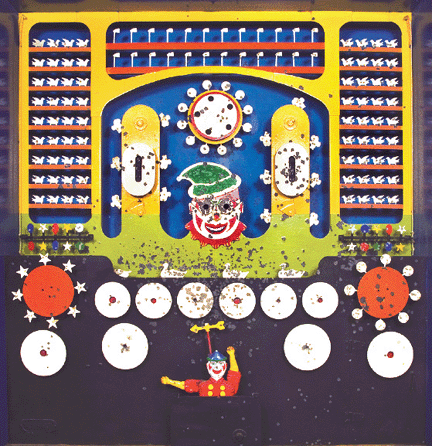
This late 19th century Mangels mechanical shooting gallery owned by Doris Duke and installed at Duke Farms sold at auction last summer for $43,200. Photo via Millea Bros Ltd

William F. Mangels, the Coney Island-based inventor of such early 20th century thrill rides as the Whip and the Tickler, also held the most patents on shooting gallery targets. From the early 1900s until 1969, well after other manufacturers had gone out of business, Mangels’ Coney Island shop turned out cast-iron and sheet-metal targets in the shape of birds and beasts, stars and moons, cowboys and Indians, and soldiers and torpedo boats.

In the early 1900s, shooting gallery operators could select from 25 different kinds of targets for “The Slide” –a chain slide mechanism– all for a dollar a piece. Ducks with moving wings could be purchased for an extra fifty cents! Today, collectors are willing to pay $200 to $1,000 per target, depending on the condition and rarity of the figure. Last June, an intact Mangels mechanical shooting gallery installed at Duke Farms and used by heiress Doris Duke during parties at her home sold at auction for $43,200! It featured a moving clown, ducks, squirrels, birds, stars and circular spinning targets. The late 19th century shooting gallery was stamped “W.F.M. Co. 389” and bears the characteristic plaque “Made by W.F. Mangels Co. – Coney Island – New York.”

ATZ can’t let February go by without honoring the memory of this amusement industry innovator’s birth. Born February 1, 1867, Mangels was best known as a developer and supplier of amusement rides and the mechanisms for carousels and roller coasters After he died on February 11, 1958 at age 92, his family carried on the business for another decade. The Coney Island History Project inducted Mangels into the Coney Island Hall of Fame and some of his kiddie rides can still be enjoyed by visitors to Coney Island’s Deno’s Wonder Wheel Park. Keep an eye out for the rides that bear the Mangels plaque.

Mangels Pony Cart Ride

Mangels Pony Cart Ride at Deno's Wonder Wheel Park, Coney Island. The Mangels plaque can be seen to the left of the numeral 8. Photo © Tricia Vita/me-myself-i via flickr

Share

Related posts on ATZ…

February 1, 2011: Bring Back the Whip! A Birthday Gift for William F Mangels

November 16, 2009: Rare & Vintage: Coney Island Sideshow Banner by Dan Casola

November 5, 2010: Museum Piece or Obsolete? Old Carnival Games, Stick Joints on eBay

June 13, 2009: June 13: Coney Island Hysterical Society Artists in Conversation at A.M. Richard Fine Art in Williamsburg

Read Full Post »

« Newer Posts