Feeds:
Posts
Comments

Archive for the ‘art’ Category

The Charmer

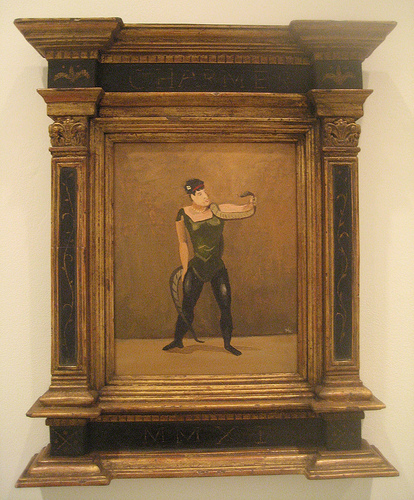
The Charmer by Mark Heyer. Oil on panel, framed. Lohin Geduld Gallery

Mark Heyer’s faux-naive snake charmer conjures up memories of cabinet cards of sideshow stars from the late 19th century. Set like a jewel in a gilded frame created by the artist, the painting is one of several circus and carnival-themed works in Heyer’s exhibition at Lohin Geduld Gallery. There’s also a sideshow talker, a circus tent being raised, an unruly circus act and daredevil motorcyclists.

“I have been painting from these types of subjects for quite some time,” Heyer told ATZ. The artist grew up going to the carnival at his hometown fair in Allentown, Pennsylvania. Coney Island’s sideshow and games were a source of fascination during the two decades he lived in Brooklyn. Heyer, who received an MFA from Parsons School of Design, moved to Mount Pleasant, South Carolina, six years ago. “I am particularly interested in slowing down things, so that cool things don’t just get swept into a dumpster. Circuses and Carnivals seem to be some of the first things that go away and don’t come back. They are something that predates us and as the corporate world grows it seems bent on getting rid of these simple, amazing pleasures.”
Mark Heyer

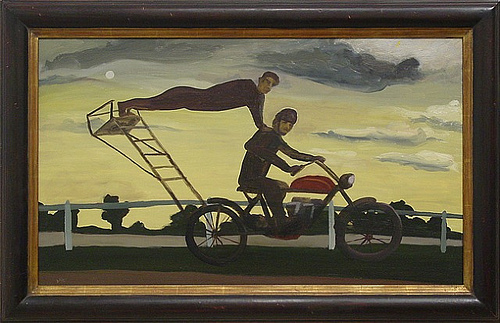
Hey Pretty, Don't You Want to Take a Ride Through My World by Mark Heyer. Oil on panel, framed. Lohin Geduld Gallery

Both Heyer’s paintings and vintage photographs have an enigmatic quality and evoke a sense of wonder. ATZ asked the artist to talk about how vintage photos inform his work and the process by which he selects and translates a photo into a painting

One thing with vintage photographs that I always make an attempt to do is acquire the photo. There is something about me being able to hold it in my hands. Like the blind searching for a different point of view. That’s not always possible, so a print out has to do. Vintage photographs are fascinating, things were slower paced, or they seem so. Often, objects in these weren’t meant to be disposable.

Usually I start my search for either circus photos or sideshow photos. Those words are what I type in. Not to be silly or anything, but I do my best to go inside that photo, as a viewer of what is happening. I come out and bring what I found to my painting. I always intend to put just enough down, so that the viewer of my work has room to add to the story. The story is never wrong, because, most times there is only a date that goes with the picture. I love it if someone adds to the story and the story continues.

Mark Heyer

All in a Day's Work by Mark Heyer. Oil on panel, framed. Lohin Geduld Gallery

The circus tent being raised. To me, it’s the preparation for what is to come. The excitement, whirlwind of imagination will all be in there. This one came from an actual photo too. I thought it was amazing because you don’t usually see this in process. To quote a painting teacher I had. “Surprise and Clarity” This picture has that I think, because it is a surprise to see what they are working on and it’s very clear what they are doing.
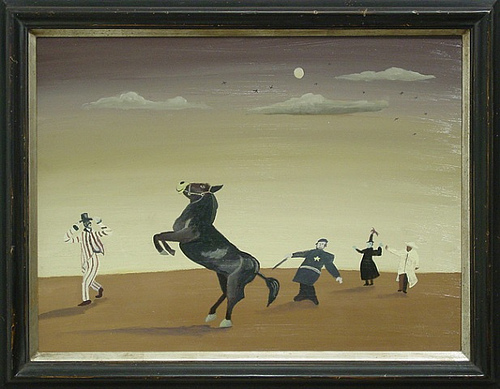
The Unruly by Mark Heyer. Oil on panel, framed. Lohin Geduld Gallery

The Unruly is the last of what you ask about. This one in particular I invite the viewer to add to the story, because who is the unruly one? The mule? The clown on the left? Or even someone in the background could have done something to start this event. In the actual photo there is a wagon also, but it wasn’t needed for what I wanted to show. I imagine this photo was staged as part of an act, I don’t really know though. It was a great image from my favorite subject matter and also allows for many different endings to the story. When I first found this photograph, I intended this one to be the image on the card. It was also the first painting that I painted for this show.

Mark Heyer, Recent Work, through December 17, 2011. Lohin Geduld Gallery, 531 West 25 Street, New York, NY, 212-675-2656

Share

Related posts on ATZ…

September 28, 2011: Rare & Vintage: Auction of French Fairground Art

January 19, 2011: Opens Jan 27: Nickel Empire: Coney Island Photographs 1898-1948

December 19, 2010: Rare & Vintage: Original Coney Island Motordrome Bike

November 16, 2009: Rare & Vintage: Coney Island Sideshow Banner by Dan Casola
Read Full Post »

dolls

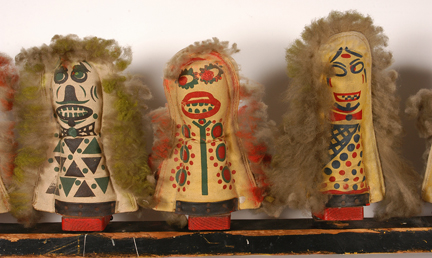
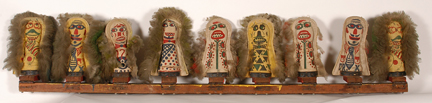
Carnival Knockdown Dolls. Slotin Folk Art Who's Who in Folk Art Auction. November 12, 2011

Remember when carnival cat racks were hand-painted and each one had its own unique personality? This tier of hand-painted canvas knockdown dolls from a vintage cat rack, also known as a doll or punk rack, will be on the auction block this weekend at Slotin Folk Art. The rack measures 74″ long x 5″ deep x 14″ high and is hinged. The pre-sale estimate is $1,000-2,000. It’s rare to find a whole row of ’em, since the majority of vintage games that have survived are broken up and sold piecemeal to collectors.

In 2009, ATZ wrote about an auction of a complete cat rack as well as a duck pond, stick joints and all, which belonged to an old-timer whose father had been in the business forever. The seller tried to preserve these pieces of Vermont fair history and offered the games in their entirety for many months on eBay, but no buyers came forward. The dolls were (and some of them still are) being sold separately for $150-$175 and the antique stick joint is now available for a mere $249!

dolls

Carnival Knockdown Dolls. Slotin Folk Art Who's Who in Folk Art Auction. November 12, 2011

The rack of nine carnival cats in Saturday’s Slotin Folk Art Auction is from the collection of George and Sue Viener, who own the Outsider Folk Art Gallery in Reading, Pennyslvania. The couple were introduced to the world of Outsider Folk Art and Americana in 1970 during a visit to the Abby Aldrich Rockefeller Museum in Williamsburg, Virginia. Viener told ATZ that he acquired the carnival doll rack a couple of years ago from a dealer in Pennsylvania. The dolls are decorated on both sides and each one is unique, unlike the standardized cat rack manufactured today. The row of dolls tips slightly forward, says Viener, which he theorized made it more difficult for players to knock them down and win the game.

dolls

Carnival Knockdown Dolls. Slotin Folk Art Who's Who in Folk Art Auction. November 12, 2011

The cat rack has already attracted online bidders and will be sold at Slotin Folk Art’s “Who’s Who in Folk Art Auction” on November 12. A larger, 21-inch tall carnival cat from the Viener Collection is also up for bid. The two-day folk art auction consists of over 1,000 lots, with the first day devoted to the Viener Collection. The live auction will be held at Historic Buford Hall in Buford, Georgia. Absentee, phone and online bidding are also available on auction days.

Carnival Knockdown Dolls. Slotin Folk Art Who's Who in Folk Art Auction. November 12, 2011

Share

Related posts on ATZ…

November 4, 2011: Up for Auction: Ringling Bros Circus Side Show Poster

September 28, 2011: Rare & Vintage: Auction of French Fairground Art

February 5, 2010: Happy Belated Birthday to Coney Island’s William F Mangels

November 5, 2009: Museum Piece or Obsolete? Old Carnival Games, Stick Joints on eBay

Read Full Post »

oldest

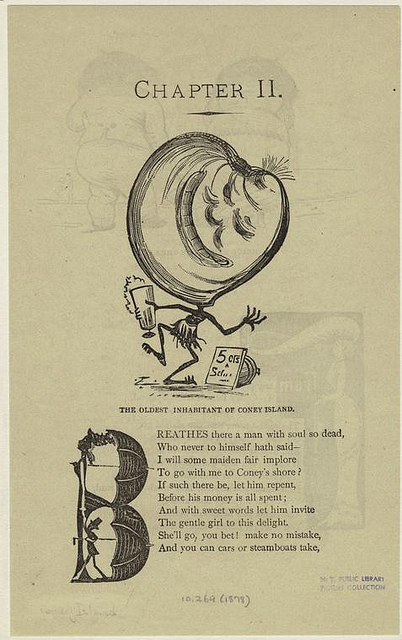
The Oldest Inhabitant of Coney Island from The History of Coney Island, 1878. Picture Collection of the New York Public Library

Coney Island’s Dancing Clams are older than the Switchback, the world’s first roller coaster (1884), and George C. Tilyou’s Steeplechase Park (1897). In fact, the frolicking mollusks are Coney’s oldest inhabitants, ATZ learned from a droll history of the seaside resort published in 1878. “The History of Coney Island from its first discovery in 4, 11, 44, down to last night, in rhyme” is a 47-page book with whimsical sketches of the summer scene from Coney’s western end at Norton’s Point to Brighton and Manhattan Beach. We also discovered that this rare volume was digitized by the Library of Congress and can be read online or downloaded to your Kindle.

chowder party

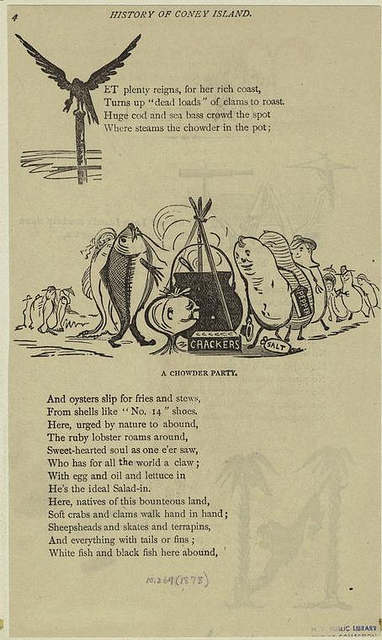
A Chowder Party: Vegetables and fish gathering around a pot of chowder from The History of Coney Island,1878. Picture Collection of the New York Public Library

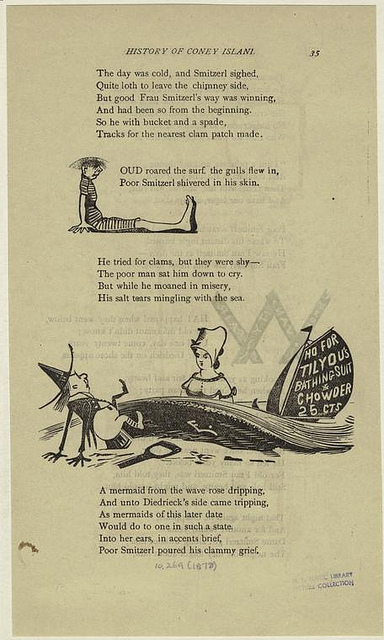
Written and illustrated by I.F. Eaton, the book was “adapted for all children under age 85, with notes by the editor (promissory ones), with maps and sketches in water color, drawings of bier, and many dry cuts.” There are a great many humorous sketches of beach-goers, including bathing beauties in Victorian dress and a mermaid startling a man digging for clams. It’s interesting to see that Coney’s Dancing Clams were not yet wearing top hats and trousers in 1878.

Last month, ATZ posted Lindsay Wengler’s photos documenting Gyro Corner Clam Bar’s hand-painted signs of top-hatted clam waiters serving clams on the half shell. Reader Beth Greenberg posted the comment “That’s one classy clam: look at his top hat and white gloves. That’s Coney Island!” Indeed, it is. Feltman’s Restaurant, where the hot dog was invented, had a famous ad in the 1900s called “The Epicure’s Parade” featuring both a top-hatted clam and a hot dog, as well as a strolling lobster, corn on the cob and mug of beer. Gregory & Paul’s, now Paul’s Daughter, has their own quirky version painted by Catherine Gavalas about 20 years ago, but my fave is their top-hatted Mr. Shrimp. Artist Richard Eagan, the co-founder of the Coney Island Hysterical Society, paid homage to the Feltman’s original with an architectural portrait of polychromed canvas and wood in 1997 and recently completed a limited handmade edition of ten.

In “The History of Coney Island,” the rhymes are as delightful as the drawings:

The hard-shell crab goes sideling by,
With murder in his little eye.
All sorts and sizes here you view,
Of those you eat and that eat you;
And you can see, in this strange spot.
How fish look ere they go to pot.

Prices were very reasonable in Coney Island back in the day: Tilyou’s Bathing Establishment, Bathing Suit and Clam Chowder, 25 cents. Bathing suit without Chowder, 15 cents. Donkey ride on the Beach, 10 cents. Clams, 5 cents. “The History of Coney Island,” 20 cents.

mermaid

Mermaid startling man digging for clams, Coney Island, N.Y. from The History of Coney Island,1878. Picture Collection of the New York Public Library

Share

Related posts on ATZ…

November 3, 2011: Scoop: Randazzo’s Clam Bar Eyeing Coney Island Boardwalk

October 14, 2011: Photo of the Day: Vernacular Signage by Lindsay Wengler

June 19, 2011: Coney Island Summer Reading: The Wonder City

December 8, 2010: Children’s Book Tells Coney Island Carousel Carver’s Story

Read Full Post »

« Newer Posts - Older Posts »