Feeds:
Posts
Comments

Archive for the ‘art’ Category

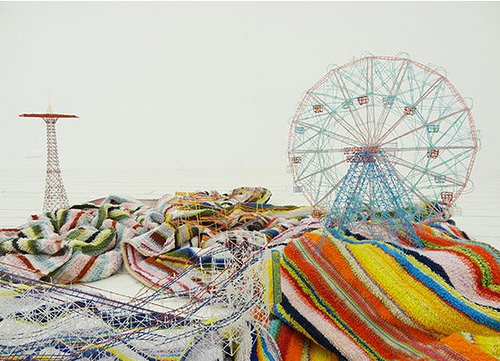
Out of Disorder (Coney Island) 2012 by Takahiro Iwasaki.

Out of Disorder (ConeyIsland) 2012 by Takahiro Iwasaki. Asia Society Museum, thru April 26, 2015

The 150-foot tall steel Wonder Wheel inspired Takahiro Iwasaki’s ethereal ten-inch tall sculpture made of fibers pulled from the beach towels on which it is perched! The miniature landscape also includes neighboring Coney Island landmarks the Parachute Jump and Cyclone.

Created in 2012 during the Hiroshima-based artist’s International Studio and Curatorial Program residency in Brooklyn, “Out of Disorder (Coney Island) 2012” is among the works on view at Asia Society in the artist’s first solo museum exhibition in the U.S. A newly commissioned piece created from kimono fibers takes its inspiration from a pair of 17th century Japanese folding screens from the Asia Society Museum Collection and will be shown alongside the six-panel screens.

Asia Society Museum is open Tuesday through Sunday from 11am-6pm and on Friday from 11am– 9pm. General admission is $12, seniors $10, students $7, and admission is free for members and persons under 16. Free admission Friday evenings, 6pm – 9pm.

“Takahiro Iwasaki: In Focus,” January 27 thru April 26, 2015 at Asia Society, 725 Park Avenue New York, NY, 212-288-6400

Related posts on ATZ…

December 13, 2014: Art of the Day: David Levine’s Watercolors of Coney Island

October 4, 2013: Art of the Day: John Dunivant’s Bizarre Midway

May 22, 2013: Art of the Day: Girl to Gorilla Showfront by Lew Stamm

September 17, 2011: Photography: Floating Above the Coney Island Boardwalk

Read Full Post »

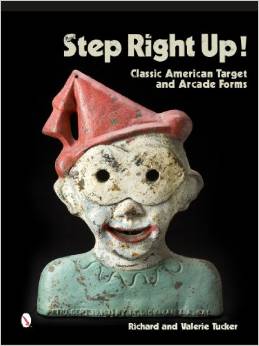
Step Right UpAfter Hurricane Sandy, Coney Island got lucky when a rare vintage 1940’s Mangels shooting gallery from Deno’s Wonder Wheel Park was brought out of storage, restored, and installed at Coney Island USA’s Surf Avenue storefront. As far as we know, it’s the only one of its kind in operation that is open to the public. Since many shooting galleries were sold for scrap iron during World Wars I and II, you’re more likely to come across cast-iron and sheet-metal targets in the shape of birds and beasts, cowboys and Indians, and soldiers and torpedo boats in folk art collections than as a game in an amusement park.

Richard and Valerie Tucker’s passion for collecting figural cast iron began in the`early 1980s with the acquisition of a row of doves from a William F. Mangels’ gallery manufactured in Coney Island. Thirty years later, they own hundreds of shooting gallery targets from a variety of manufacturers. Step Right Up! Classic American Target and Arcade Forms is a sumptuous coffee table art book with more than 225 color images of American and European targets along with a sampling of carnival banners, signs and game pieces. As the first and only book on the subject, the volume is valuable to collectors and of special interest to fans of carnival art and antiques.

In addition to Mangels, the 144-page book has chapters on C.W. Parker of Kansas, William Wurfflein of Philadelphia, the John T. Dickman Company of Los Angeles and Chicago manufacturers Evans, Hoffmann, Mueller, and Smith, as well as miscellaneous targets and a few European targets. Essays by specialists on the manufacturers supplement illustrations from the Tuckers’ archive of catalogs, trade cards and other ephemera which are a great resource since the majority of targets have no trade marks.

Step Right Up! Richard and Valerie Tucker

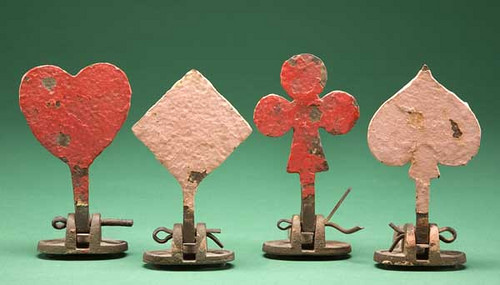
Card Suits by WF Mangels. Private Collection. Photo: Kimberly Gavin/Kimberly Gavin Photography

One of our favorite target makers is C.W. Parker, who started out as a shooting gallery operator and soon got into the business of supplying traveling carnivals with a wide variety of attractions. Parker had a showman’s flair for borrowing design ideas from his fellow manufacturers and fashioning them into commercially successful shooting galleries and carousels.

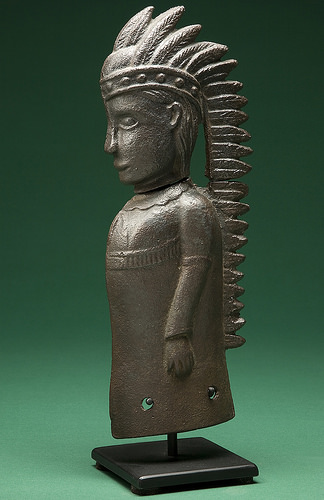
No complete Parker galleries are known to exist or even to have been photographed, says Bob Goldsack, a Parker historian who wrote the book’s chapter on the self-proclaimed “Carnival King.” Parker’s highly detailed and mechanized targets included owls and eagles with flapping wings, whippets chasing rabbits, and the now politically incorrect circus animals, Indians, and Lincolnesque figure holding a sign that says “Hit Me” in a gallery advertised as “A New Political Shooting Gallery.”

A lecture and book signing by the authors will be held at the American Folk Art Museum, 2 Lincoln Square, Columbus Ave at 66th St, in Manhattan, on December 18 at 6pm. Admission is free of charge.

Step Right Up! Classic American Target and Arcade Forms by Richard and Valerie Tucker. Schiffer Publishing, 2014. Hardcover, $45

Step Right Up! Richard and Valerie Tucker

Indian by CW Parker. Photo: Kimberly Gavin/Kimberly Gavin Photography

Related posts on ATZ…

September 5, 2013: Photo of the Day: Restored WF Mangels Shooting Gallery

February 28, 2013: Coney Island Shooting Gallery from 1940s Makes Comeback

September 28, 2011: Rare & Vintage: Auction of French Fairground Art

February 25, 2010: Happy Belated Birthday to Coney Island’s William F Mangels

Read Full Post »

David Levine Forum Gallery

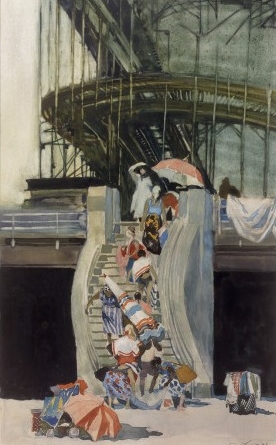
David Levine at Forum Gallery, Past and Present, 1993, watercolor on paper, 14 13/16 x 10 inches, Collection of The Columbus Museum, Columbus, GA

For this long-time admirer, seeing one of David Levine’s sublime and instantly recognizable watercolors of Coney Island on the cover of Gallery Guide was a joyful moment, knowing it heralded more. From December 12 through January 17, Forum Gallery presents “David Levine: The World He Saw,” the first major exhibition of paintings and drawings by Levine since his passing in 2009. Fifty works are on view including more than 25 of his watercolors of Coney Island, many loaned by private collectors and museums.

Renowned as a caricaturist whose insightful drawings were on the cover of The New York Review of Books for more than 40 years, Brooklyn-born Levine spent his summers painting the bathers on Coney Island beach and the architecture on the boardwalk and adjacent streets. Many of the structures that he painted–pavilions, booths, bathhouses, and amusement rides, have since vanished or were demolished.
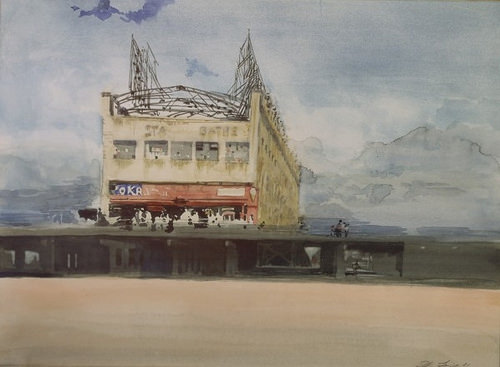
David Levine Forum Gallery

David Levine at Forum Gallery, Stauch’s Baths, 1981, watercolor on paper, 10 7/8 x 14 5/8 inches, Private collection, San Francisco, CA

While photographs of Coney’s past attractions tend to put a “then and now” distance between the viewer and the subject, the immediacy of watercolor and Levine’s mastery of the medium makes us see what he saw. Then is now. The ache in the heart upon viewing his watercolors of Stauch’s Baths, the Bank of Coney Island building and the original Thunderbolt roller coaster is akin to phantom pain for a limb that has been lost.

There are also paintings of rides that are thankfully still with us– the Polar Express, the B&B Carousell–and of elderly women whom Levine affectionately referred to as the “Shmata Queens of Coney.”
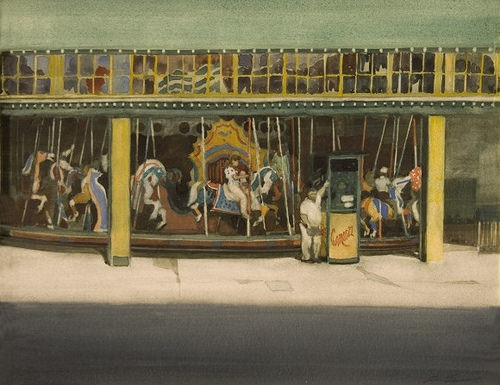
David Levine Forum Gallery

David Levine at Forum Gallery, Carousel, 1989, watercolor on paper, 11 3/8 x 14 1/4 inches

“Each year they would say: ‘Ya know, lest veek, dere vuss a men chust like you.’ I would patiently tell them that it was me,” Levine wrote. “The ‘shmata,’ or ‘rag,’ not only refers to the head cloth, but also to the bathing suits – faded and misshapen by molding to aged and deformed bodies that have been out under the sun. They are now comfortable with me sketching in their midst and only occasionally ask to see what I do.”

Walter Bernard, a fellow member of the Painting Group, which Levine co-founded with Aaron Shikler in 1958, wrote this remembrance in the New York Times in 2010: “Watching David work was a revelation. He handled watercolors unlike anybody else. He liked to experiment and, as he put it, ‘play.’ He would draw, redraw, ‘schmeer,’ sponge out and paint again. It was not uncommon to see him rub out a work we’d been marveling over, saying, simply, ‘I didn’t get what I was going after.'”
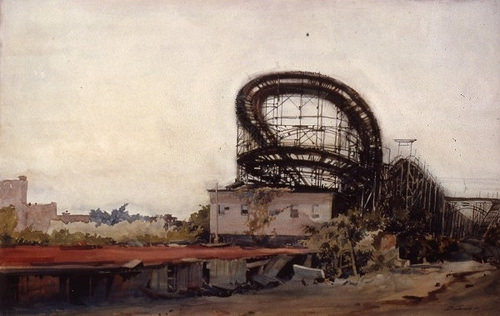
David Levine, Forum Gallery

David Levine at Forum Gallery, End of Youth, 1984 watercolor on paper 14 x 22 1/2 inches, Private collection, New York, NY

Levine often painted the 1925 Thunderbolt, which was SBNO (Standing But Not Operating, in roller coaster parlance) since the early 1980’s. The titles of the works are telling: End of Youth, End of Joy, Goya at Coney, and after it was demolished in 2000, The Past.

One of the stories Levine told about the people he met while painting in Coney is this poignant anecdote about End of Joy: “I was seated on a side street, painting the Tinturn Abbey of joy rides, the Thunderbolt. Black and looming, it stood abandoned. A group of children surrounded me. They had just left the beach. Their chattering stopped as they watched my performance. Then, silently, they moved off as a group. When they had walked a short distance, the smallest, a little girl, turned and ran back to me. Without a word, she placed a quarter on my watercolor, then returned to her friends.”

A 72-page, fully illustrated catalogue, with foreword by author and journalist Pete Hamill, accompanies the exhibition.

David Levine: The World He Saw. December 12, 2014 to January 17, 2015. Forum Gallery, 730 Fifth Avenue 2nd Fl. (between 56th & 57th Streets), New York, NY 10019. 212-355-4545. Gallery hours are Tuesday through Saturday, 10am to 5:30pm
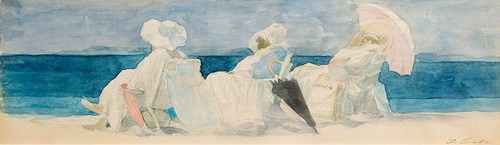
David Levine Forum Gallery

David Levine at Forum Gallery, Untitled (Three Women, Two Umbrellas on beach), 1982, watercolor on paper, 4 1/4 x 13 3/4 inches

Related posts on ATZ…

October 4, 2013: Art of the Day: John Dunivant’s Bizarre Midway

May 22, 2013: Art of the Day: Girl to Gorilla Showfront by Lew Stamm

August 21, 2012: Art of the Day: Out of Disorder (Coney Island) by Takahiro Iwasaki

September 17, 2011: Photography: Floating Above the Coney Island Boardwalk

Read Full Post »
« Newer Posts - Older Posts »