Step right up and see “Double Trouble,” an early 20th century peep show reel. Yes, it’s SFW though dancers wearing short skirts were considered risque when this moving picture machine was new. Invented in 1894 and marketed by the American Mutoscope Company, the coin-op machines contained flip book movies with a viewing time of about a minute.
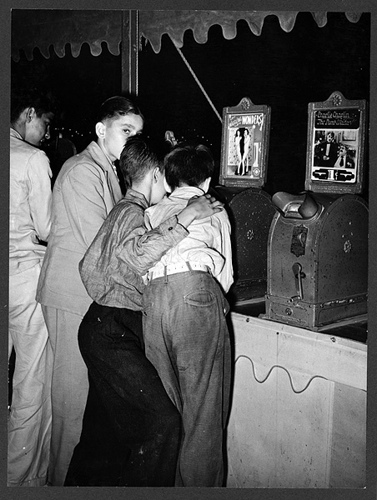
These classic reels were made from 1897 to 1907, when the company turned completely to projection, and were created and almost totally produced in New York City. Although the 4,000-plus titles included a variety of subjects, it was the girly movies with suggestive titles like “Artists and Models” and “Wiggling Wonders” (glimpsed in the photo below) that won notoriety.
Mutoscope machines were popular in Coney Island and the Rev. Frederick Bruce Russell of the Law and Order Society raided and closed several for the exhibition of improper pictures on July 30, 1897. “Those closed by Mr. Russell to-day were at Feltman’s Pavilion, Koster’s Concert Hall, the Sea Beach Palace and the Old Iron Pier,” said an article on the front page of the Brooklyn Eagle. “The particular pictures which fell under the reformer’s eye were entitled ‘What the Girls Did With Willie’s Hat’ and ‘Fun in a Boarding School.’”
What did the girls do with the hat that was so scandalous? They frolicked and kicked it high over their heads while wearing short skirts like the girls in “Double Trouble.” Bring back the peep show! It would be fun to have some of these old Mutoscope movie machine as well as an arcade museum as we noted previously in “ATZ’s Big Wish List for the New Coney Island,” ATZ, October 7, 2012).
Boys looking at penny movies at South Louisiana State Fair, 1938. Photograph by Russell Lee. Library of Congress Prints & Photographs Division
The most popular videos posted on Amusing the Zillion in 2012 include a music video by a country star, new films by Coney Island photographers Charles Denson and Jim McDonnell, two films that premiered at festivals in 2012 and rediscovered footage from Coney’s past.
Coney Island is a long way from Nashville, but in December 2011 country singer Alan Jackson was spotted filming a music video on the Boardwalk. Released in January, this poignant ballad about the end of a love affair had the very likeable Jackson singing “I’ll be the SOB, if that’s what you need from me. So you don’t have to love me anymore.” The shuttered stores and lonely beauty of Coney Island on a December day suit the lyrics, which are sorrowful yet defiant, in the way that the best country songs often are. (“Music Video: Alan Jackson’s So You Don’t Have to Love Me Anymore,” ATZ, January 13, 2012)
Coney Island historian Charles Denson’s 10-minute film of “Climbing the Parachute Jump” was released in January via his “Coneyologist” Channel on YouTube. Featuring video footage by Seth Kaufman and his own exquisite photos, Denson’s film captures the fulfillment of his boyhood dream to once again see the view from the top. “I grew up a few blocks from the Jump and have documented it since it closed,” he writes. “When the city decided to dismantle and renovate the Jump ten years ago, my engineer friend Seth Kaufman had the only copy of the original plans. The city needed them so we made a deal: We got to climb it legally.” (“Video of the Day: Climbing Coney Island’s Parachute Jump,” ATZ, January 18, 2012)
ATZ found this spoof of Robin Leach’s Lifestyles of the Rich and Famous from an early Conan O’Brien Show in which comedian Andy Richter and actor Abe Vigoda travel to Coney Island on a rainy day in December 1994. “Come join the stars as they escort Andy Richter to their wonderful weekend getaways on Runaway with Andy,” Leach says in the intro. He describes Coney as “a sleepy island of exotic delight.” You’ll catch glimpses of such vanished attractions as Faber’s Sportland Arcade, the Thunderbolt roller coaster, Hell Hole, Jumbo Jet, the Zipper ride, and a food trailer called Trashy Trudy’s Goodeating. (“Blast from the Past: Andy & Abe Tour 1994 Coney Island,” ATZ, February 9, 2012)
“Coney Island Lights” by photographer and self-described “footage guru” Jim McDonnell is lyrical and bewitching thanks to masterful editing by McDonnell, who knows Coney Island and has a talent for distilling its essence into a short film. Watch for Luna Park’s Air Race ride, the dancing lights of the landmark Cyclone and Wonder Wheel, and the blinking red eye of the Spook-A-Rama Cyclops (“Video of the Day: Coney Island Lights by Jim McDonnell,” ATZ, July 8, 2012)
This is the trailer for Amy Nicholson’s Zipper: Coney Island’s Last Wild Ride, the award-winning new documentary about the rezoning and redevelopment of Coney Island. “A small-time ride operator and his beloved carnival contraption become casualties in the battle over the future of Coney Island” is the film’s capsule description. Eddie Miranda’s Zipper represents all of the mom-and-pops who were displaced by the real estate speculation that was set off by the Bloomberg administration’s plan to rezone Coney Island. ATZ reviewed the film when it premiered at DOC NYC in November. (“Film Trailer: Zipper, Coney Island’s Last Wild Ride,” ATZ, July 26, 2012)
ATZ happened to come across this raw footage shot in early 1960s Coney Island from the collection of Anthology Film Archives. The clip above titled “Coney Island – Night – Silent work-print” has atmospheric scenes of a grand carousel, amusement games and Nathan’s packed with people. The “Steeplechase Carousel” was on the Boardwalk at 16th Street and according to a reader, its frame and some of the Illions horses are likely part of the Flushing Meadows carousel today. (“Video of the Day: Raw Footage of 1960s Coney Island,” ATZ, August 27, 2012)
Posted on Labor Day, “Coney Island Dancing 2012″ opens with the legendary Tony Disco before segueing to the legendary dancing mannequin known as “Miss Coney Island.” For the past two seasons, photographer and film editor Jim McDonnell has released an annual video of the season’s best dance moves on the Boardwalk and the Polar Express and at Luna Park, Wonder Wheel Park and the Mermaid Parade and Ball. Here are links to his dance vids from 2010 and 2011 in case you missed ’em. Party on!(“Video: Coney Island Dancing 2012 by Jim McDonnell,” ATZ, September 13, 2012)
“Gotta Love Coney Island” by Brooklyn native and Coney Island regular Jay Singer is frenetic and hypnotic. It was one of the films in ATZ’s “5 Coney Must-Sees at the Coney Island Film Festival”, where it premiered in September. “It is 275 separate scenes at various speeds composited into a ‘one reel’ experimental film,” Jay told ATZ. “The goal was to capture the ‘pulse’ of Coney Island on a busy day, with intercuts of vintage footage filmed by my grandfather alongside contemporary footage of my own.” (“Video of the Day: Gotta Love Coney Island by Jay Singer,” ATZ, September 25, 2012)
Coney Island History Project director Charles Denson rode out Hurricane Sandy in Sea Gate where his apartment flooded up to the windows and his car floated away. He posted this dramatic video footage of Sandy making landfall at Sea Gate on October 29th. (“Photos of the Day: Devastation at Coney Island’s Sea Gate,” ATZ, November 1, 2012)
Set to “I Remember Coney Island,” a 1981 recording by the Lounge Lizards, Dave Pentecost’s Coney Island Time Lapse features footage shot in the summer of 2012 of the Wonder Wheel, Brooklyn Flyer and other amusement rides in action. “This circular fisheye video is intended to be projected in the digital dome in the new Lower Eastside Girls Club community science and art center,” says Pentecost. (“Video of the Day: Coney Island Time Lapse by Dave Pentecost,” ATZ, December 3, 2012)
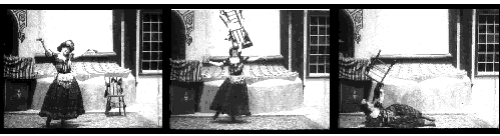
Princess Rajah was a $1000-per-week headliner on the Keith Vaudeville Circuit in the early 1900s who got her start as a cooch dancer in Coney Island in the 1890s. Her Arabian Chair Dance, seen in this 1904 film, as well as her Cleopatra Dance, were described in rave reviews as entirely unlike anything shown on the stage. The dance was filmed by the American Mutoscope and Biograph Company on May 23, 1904, at the Louisiana Purchase Exposition in St. Louis. Princess Rajah was a featured act in the “Mysterious Asia” concession on the Pike.
“In her Chair dance, the Princess amazes by her strength, particularly her strength of jaw. Taking between her teeth a substantial looking chair, she swirls and swings through a dance that would be intricate and difficult enough were her head entirely free,” according to a 1915 review in the Boston Daily Globe. “Never does her hand touch the chair, and the feats she performs with it are almost incredible.”
In 1909, Broadway impresario William Hammerstein “discovered” the Cleopatra Dancer at Huber’s Museum on 14th Street. “I had the greatest surprise of my career when I discovered that a genuine artist was being hidden away in a dime museum,” he told the New York Times. “In fact I am at a loss for words to describe this Cleopatra dance. She does not depend upon the undraped figure to reveal her art but uses a peculiar kind of Oriental costume that is a marvel in itself. She uses real snakes, too.”
Two weeks later the Princess, whose real name was Rose Ferran, made her vaudeville debut as the star attraction at Hammerstein’s Victoria Theater on 42nd Street. Heavyweight champ Jack Johnson was also on the bill and was reported to have leaped onto the stage and sucked the venom from her veins when a snake bit her. It sounds like an inspired bit of press agentry but in later descriptions of the Cleopatra Dance, Princess Rajah is said to clutch the snake to her bosom and allow it to bite her when she comes upon a statue of her dead lover Marc Anthony. Then follows a death fall down a flight of stairs that is a thriller, according to reviews. Alas, the Cleopatra dance is not preserved on film.
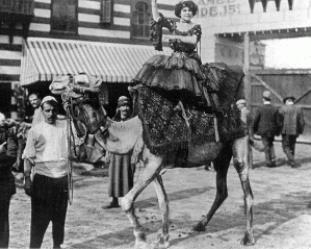
Princess Rajah greets visitors at Akoun’s Beautiful Orient and Streets of Cairo at the Jamestown Exposition in 1907. Photo via Norfolk Public Library



 Amusing the Zillion