Stillwell Terminal is lined with vivid posters for Ringling’s Coney Island Illuscination, which opens on June 17, and for Deno’s Wonder Wheel Park, whose landmark Wonder Wheel celebrates its 90th birthday this year! On Friday, Ringling’s sleek blue-and-yellow striped circus tent was raised for its second season in Coney Island. Photos of the tent raising from start to finish can be found in Ringling’s photo album on Facebook as well as Amanda Stevens’ flickr set.
In 2009, the Coney Island circus made history by bringing “The Greatest Show On Earth” back under “The Big Top” for the first time since 1954. Justin Case, who rode a tiny bicycle through a ring of fire, was our favorite performer in last year’s Coney Island Boom-A-Ring. This season’s all new show features illusionist David DaVinci, a trio of Italian clowns, Russian acrobats, Chinese Kung Fu masters and more!
Coney Island Illuscination's Empresses of the Air, Widny Neves and Viktoriya Medeiros. Photo via Ringling Coney Island's Facebook
Last month ATZ had a history trivia contest to give away two Family Four Paks for opening weekend of Coney Island Illuscination. Readers who sent in correct answers were eligible for a drawing for the circus tickets. Congrats to our two winners –Bill F. of Old Bethpage, NY, and Jim A. of Smithtown, NY. Enjoy the show!
Bill and Jim were among several people who correctly answered question # 2: “Tell us the name of a Coney Island attraction that was named after a member of the inventor’s family! Name of inventor and relationship to family member also required!” One correct answer is Luna Park–the original Luna Park, of course– which opened in 1903 and was named after park co-owner Elmer “Skip” Dundy’s sister Luna. Another correct answer is the Virginia Reel, a popular ride that made its debut in 1908 at Luna Park. It was designed by Henry E. Riehl, who named the ride after his daughter, Luna Virginia Riehl. With the rebirth of Luna Park Coney Island, will Luna become a popular girl’s name once again?
The Virginia Reel at Luna Park, 1910. Library of Congress, Prints and Photographs Division via flickr
One of the 19 rides set to debut in Coney Island’s new Luna Park this summer is Zamperla’s Wild Mouse spinning coaster, which has been rechristened “The Tickler” after the innovative 1906 thrill ride in the original Luna Park. Here’s the ride manufacturer’s official vid of their Twister Coaster. If you’re at work, you may want to mute the music before going for a spin…
While it’s customary for parks and carnivals to rename or re-theme a ride, the Tickler name holds special significance in the history of amusement rides and of Coney Island. The Tickler was the first amusement ride “designed to jostle, jolt and jounce its riders about in their seats when the ride was in motion,” according to its inventor and manufacturer William F Mangels.
As the cars went bumping and whirling down an incline that resembled a pinball machine, riders clung to each other to keep from falling out. It’s no wonder the Tickler became the perfect date ride for couples who wished to get speedily acquainted. “If a man comes in sedate and solemn, all he needs is one good trip in ‘the tickler’ to set him going like all the rest,” said Luna Park manager Frederic Thompson in a 1908 interview with the New York Times. “It is all the old principle of the small boys sliding down their cellar doors!”
We’ve been a fan of William F Mangels’ classic Whip ride since our days as a carny kid. Colbert’s Fiesta Show had a roto-whip that we used to ride in marathon sessions with our doll. It’s a shame that Coney Island, the birthplace of the Whip, remains Whip-less, while Rye Playland, Dorney Park and Kennywood boast 12- and 16-car models. That’s why we’re tickled pink (when was the last time we heard that quaint phrase much less got to use it!) that Zamperla is paying homage to Mangels by christening their Coney Island coaster “The Tickler.” It’s sort of like naming your kid after his illustrious great-great-great grandfather!
Hailed as “The Wizard of 8th Street” by historian Charles Denson of the Coney Island History Project, Mangels (1867-1958) was posthumously inducted into the Coney Island Hall of Fame. In his book The History of the Outdoor Amusement Industry, Mangels recalls bringing his sketch of the 1906 ride to Luna Park to apply for a location for the following season.
Frederic Thompson, then the manager, took the picture, held it at arm’s length and gazed at it a minute. Then in his brusque way, he said, “You will need barrels to take away your money. Come in tomorrow morning for your contract.” The contract specified that twenty per cent of the gross receipts should go to the park.
The Tickler consisted of a wide, inclined platform, sloping upward from the entrance. On this platform a sinuous course was fixed by posts and rails, and through it a number of circular cars were operated. They were mounted on swivel caster wheels and had large rubber bumping rings on the exterior. The operation was simple. After the passengers had been seated, the cars were drawn up an incline by a chain conveyer. At the top, they entered the downward course and by gravity careened, bumped and whirled back to their terminal, tossing the passengers violently about in their seats. At the end of the jounrey, the five passengers were usually scrambled together so hopelessly that attendants had to help them disembark.
This new ride had cost $6,000 to install. It enjoyed heavy patronage from the start, grossing $42,000 the first season plus a substantial sum from royalties. Although the theory of the promoter seemed sound within a few seasons the novelty wore off and business declined.
Fairy Gorge Tickler Amusement Ride, Pay Streak, Alaska Yukon Pacific Exposition, Seattle, Washington, 1909. UW Digital Collections via flickr
Advertised as “A Scream from Start to Finish,” the Tickler was featured at amusement parks across the country and the Alaska Yukon Exposition of 1909. It paved the way for the scream machines that we enjoy today. The ride’s rival and immediate successor, the Virginia Reel built by Henry Riehl in Luna Park in 1908, was the first true spinning coaster. Although the Wild Mouse Spinning Coaster did not arrive on the amusement scene until the late 1990s, its lineage can be traced back to Coney Island’s Tickler and Virginia Reel.
The British writer P.G. Wodehouse, who was living in Greenwich Village when the Tickler made its debut, went for a spin on the brand-new ride and wrote the following review..
The principle at the bottom of Coney Island’s success is the eminently sound one that what would be a brutal assault, if administered gratis, becomes a rollicking pleasure when charged for at the rate of fifteen cents per assault. Suppose one laid hand upon you and put you in a large tub; suppose he then proceeded to send the tub spinning down an incline so arranged that at intervals of a few feet it spun around and violently bumped into something. Next day he would hear from our lawyer. But in Coney Island you jump into the Tickler and enjoy it; you have to enjoy it because you have paid good money to. Being in America, Coney Island is thought a little vulgar; if it were in France we would have written how essentially refined the the Tickler and the Human Roulette Wheel were, and with what abundance the French took its pleasure.”
It makes us wonder what Wodehouse would have written about the new Italian coaster in Coney Island.
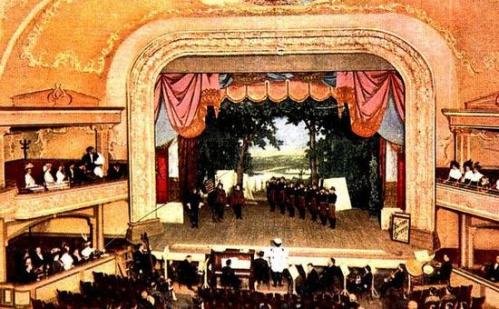
On Wednesday at the Brooklyn Central Library, theater historian Cezar Del Valle will give an illustrated talk on the history of the Legitimate Stage, Vaudeville, Burlesque and Minstrel Show in Brooklyn’s three entertainment districts: Fulton Street, Eastern District, and Coney Island.
Vintage Postcard of Henderson's Music Hall Stage in Coney Island. Cezar Del Valle Collection
Del Valle’s area of expertise is New York City popular entertainment between 1850 and the 1950s, including special emphasis on actual theater buildings. He has led walking tours of the lost theaters of Coney Island’s Bowery. “In its fabulous heyday, the resort was more than just rides and arcades; it was home to numerous cabarets, variety halls and movie shows – a training ground for a generation of legendary performers,” says Del Valle.
The subject is timely since Coney Island’s two historic theater buildings–the Shore Theater and the Henderson Music Hall— have been nominated for New York City landmark designation by Coney Island USA. A March 23 public hearing date has been set for the Shore Theater, a 2,500 seat movie and vaudeville house built in 1925. The building has been shuttered by owner Horace Bullard since the 1970s. Sources tell ATZ the City is trying to acquire the Shore Theater with the idea of reviving it as a year-round entertainment destination.
Also up for landmarking on March 23 is Coney Island USA’s Building (former Childs Restaurant), which is currently in use as a theater for the Coney Island Sideshow and Burlesque at the Beach. The second floor houses the Coney Island Museum. In 2008 the non-profit arts organization bought the 1917 building with $3.6 million funding from the City.
The Henderson Music Hall has yet to be calendared. Its chances of gaining landmark designation are thought to be slim since the building has been altered extensively. It was even cut in half! There’s also the unfortunate fact that the Henderson is owned by real estate speculator Joe Sitt of Thor Equities and occupies a prime site at the corner of Surf and Stillwell that has been rezoned for a high rise hotel. City rezoning documents detail the history of the Henderson Music Hall:
Fred Henderson opened the 3-story brick music hall on Stillwell Avenue at the Bowery around 1900. Henderson’s establishment began as a restaurant at Bowery and Henderson Walk in 1881. When that building burned in 1899, Henderson constructed the new structure to the designs of John B. McElfatrick. The original Italianate southern façade (which fronts on the Bowery) has brick piers, corbelling, stone window lintels, and a bracketed cornice. In 1923, Stillwell Avenue south of Surf Avenue was created by the widening of Stratton’s Walk, and Henderson’s Music Hall was cut in half. At that time, a new brick façade with decorative panels and a stepped parapet was added to the Stillwell Avenue frontage. Additional alterations include modern storefronts and replaced windows. The music hall operated until 1926 and featured such music and vaudeville acts as Al Jolson, the Marx Brothers, and Sophie Tucker. During its run, Henderson’s Music Hall was an important Coney Island entertainment venue. From 1926 to 1984, the building housed the World of Wax Musee. The former Henderson’s Music Hall has been extensively altered. This property was identified in the inventory of potential resources prepared by Coney Island USA.
February 24, 7:00 pm, “Brooklyn Stages,” Brooklyn Collection Reserve Room at Brooklyn Central Library, 10 Grand Army Plaza, Brooklyn, 718- 230-2762. “Seating is limited so come early and join us for wine and cheese from 6:30 to 7.”




 Amusing the Zillion