Feeds:
Posts
Comments

Archive for the ‘Redevelopment’ Category

Coney Island Post-Dandy

Coney Island Post-Sandy: Interior Demolition of Storm-Ravaged Denny’s Ice Cream, Surf Avenue. November 17, 2012. Photo © Tricia Vita via flickr

One of the first casualties of Sandy in Coney Island’s amusement area could be replaced with mini-golf or a roller rink. Which do you prefer? Over the weekend, while storm-ravaged Denny’s Ice Cream on Surf Avenue was being gutted by volunteers, Coney Island USA founder Dick Zigun asked his followers on twitter: “Miniature Golf or Roller Rink to replace Denny’s Ice Cream? Opinions so far polling 50/50 & no one supports Paint Ball or Spin Art…hmm…”

Last week, word on the street was that the beloved ice cream shop established in 1978 and now owned by CIUSA would become a paintball game emporium a la Shoot the Freak. Replacing the ruined ice cream machines would be too costly for the arts organization, whose Freak Bar and theater next door was also damaged by the storm.

Dick’s new proposals signaled the start of a social media battle between #TeamRollerRink and #TeamMiniGolf. Just so you know, ATZ has added “Artist-Designed Mini-Golf Enthusiast” to our resume. We see the attraction as a quirky new successor to the mini-golf that used to be part of Batting Range and Go Kart City on Stillwell Avenue. There’s no reason it can’t also be a Black Light Mini-Golf with freaky interactive holes and a booth selling Denny’s signature banana pistachio soft serve and other fave snacks. #TeamMiniGolf had this to say….

The nonprofit arts organization bought Dennis Corines’ ice cream shop and building next door to Coney Island USA’s headquarters last March for $1.3 million. At the time, Zigun told ATZ: “Since we own an ice cream parlor and have no money to renovate, Denny’s might or might not continue next year. Even once we renovate the building will maintain a 500-square-foot storefront taking up most of Surf Avenue frontage that will always serve light food to street plus lobby inside.”

“Some day we can transfer air rights from the landmark Childs Building, match the two-story front of Childs then do a setback with an additional five to seven story tower on top of the base,” Zigun noted. The renderings that he showed last year at a Coney Island presentation at the AIA included a whimsical homage to the Elephant Hotel, which in the meantime would make a dandy hole for Mini Golf. Unless of course #TeamRollerRink wins this one…

https://twitter.com/DarlindaJust/status/270598207095074817

Share

Related posts on ATZ…

November 21, 2012: Coney Island Post-Sandy: Flooded Spook-A-Rama to Get New Stunts

November 13, 2012: Coney Island’s Eldorado Wins Lease But Bumper Cars Soaked by Sandy

November 9, 2012: Update on Coney Island’s Amusement Area After Sandy

October 30, 2012: Photo Album: Hurricane Sandy’s Aftermath in Coney Island

Read Full Post »

Zipper

Larry posing with Freddie on the very last night of operation – Labor Day 2007. Freddie was a great loader and would spin the cars before the ride even started! Photo © Zipperfilm.com

Five years in the making, the long-awaited Coney documentary Zipper premiered Saturday at DOC NYC and screens again today at 3pm and 9:30pm. The theater is the IFC Center on 6th Avenue at West 3rd Street in Manhattan. The first time we met director Amy Nicholson was in Coney Island on September 9, 2007, the last day of Astroland, which later got a one-year reprieve from landlord Thor Equities. As Amy and cinematographer Jerry Risius loaded equipment into a car, she explained they were making a film featuring the Zipper. The ride had also been evicted by Thor and eventually they would film it being driven away.

“A small-time ride operator and his beloved carnival contraption become casualties in the battle over the future of Coney Island” is the film’s capsule description. Eddie Miranda, who worked on Coney Island’s rides since he was a boy, owned and operated the Zipper and Spider for a decade. In the doc, Eddie’s Zipper represents all of the mom-and-pops who were displaced by the real estate speculation that was set off by the Bloomberg administration’s plan to rezone Coney Island. The names of the businesses, including Batting Cage and Go Kart City, Shoot Out the Star, Shoot the Freak and Steve’s Grill House, are memorialized on the screen in the final credits.

Zipper Film

It was hard to take the Zipper apart because it hadn’t been disassembled since it was parked on that spot – almost 10 years. Photo © Zipperfilm.com

Eddie and his Zipper crew–Don, Joe, Larry and Jerry–are a likeable bunch of guys who cut up jackpots about how far back they go in Coney and with each other. Watching them disassemble the Zipper is heartbreaking, all the more so because in the film, this scene happens as the City Council votes “Aye” on the rezoning that will shrink the amusement zone and allow retail and high rises on the south side Surf Avenue. It’s poetic license because the vote was held in July 2009, two years after the Zipper had left Coney Island. But it is exactly right, because the land remained vacant all that time. The Zipper site is presently part of Wonder Wheel Way and Scream Zone, which along with Luna Park was built after the City ended the stand-off with Joe Sitt shown in the film and bought 6.9 acres of his land for $95.6 million in November 2009. “It’s a vision offering major new opportunities for retailing and thousands of new housing units,” says Mayor Bloomberg at the City Hall press conference announcing the land deal and the City’s own redevelopment plan for Coney Island.

The film does a great job of making the complex details of the Coney Island rezoning easy to comprehend with snappy graphics, newspaper headlines (“Rezonie Baloney” is a fave), and TV clips of reporters covering the Coney beat. Interviews with Amanda Burden, Director of the New York City Department of City Planning, Coney Island’s City Councilman Domenic Recchia Jr., and Thor Equities CEO Joe Sitt speak louder than words. One of the most effectively edited sequences has the trio taking turns saying what kinds of retail the new zoning would allow them to bring to Coney Island. Suggestions range from entertainment franchises like Ripley’s Believe It Or Not, Howie’s Game Shack, and Build-A-Bear Workshop (Sitt) to Williams-Sonoma (Recchia), Gap and Duane Reade (Burden). As we said in a previous post: Ugh. Sounds like Any Vacation Spot, USA. Cut to Zipper crew members Joe and Don, who look stunned. “They could care less about the amusement business, about Zippers,” says Don.

Zipper film

From the wall in Harold Chance’s office: homage to the greatest ride ever, the Zipper. Photo © Zipperfilm.com

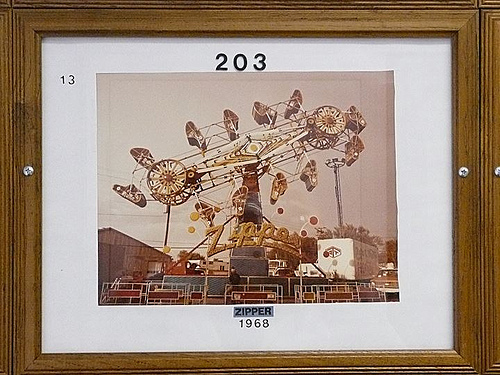
But the film makes viewers care about Zippers. It takes us to Chance Rides factory in Wichita, where the classic ride was invented in 1968 and the company’s elderly founder Harold Chance is interviewed. We learn there were only 224 built and Coney Island’s Zipper is number 34. Seeing the Zipper for the first time since it left Coney Island for a seaside carnival in Honduras, tears welled up. They have our Zipper! At the same time, we felt happy to see it still alive and thrilling riders. The irony is that the three members of the Zipper crew who managed to find another place to work in Coney Island are about to lose their jobs again. On the weekend of Zipper’s premiere, they were busy dismantling the rides in McCullough’s Kiddie Park since it has closed forever after 50 years. The family that owns the park wasn’t able to come to an agreement on extending the lease with property owner Thor Equities.

Share

Related posts on ATZ…

September 4, 2012: Exclusive: McCullough’s Kiddie Park Closing After 50 Years in Coney Island

July 19, 2011: Video of the Day: Let Us Now Praise Coney Island’s Zipper

April 12, 2010: Evicted by Thor, Coney Island’s Zipper Ride Thrills in Honduras

March 3, 2010: Thor’s Coney Island: What Stillwell Looked Like Before Joe Sitt

Read Full Post »

PLayland Arcade

Playland Arcade Building, August 12, 2012. Photo © me-myself-i/Tricia Vita via flickr

Demolition began today of the long vacant Playland Arcade, which has been closed since 1981. The interior walls were gutted by a demo crew using a small bulldozer. Asbestos removal is slated for Thursday with the exterior walls expected to come down soon afterwards.

ATZ asked former arcade operator and Coney Island regular Stan Fox, who operated Playland with his brother from 1957 until 1971, how he felt seeing the last of the arcade. “As I would walk by the empty arcade thousands of times over the years, in my mind’s eye I would see the ghosts of people who worked in Playland,” said Fox. “I would hear the sound of Skee-Ball going up and down the alleys, the ka-chunk of the plates rolling over, the ding-ding of the pinball machines and the jingling of coins being emptied into change bags.”

Owned by Horace Bullard, the Playland building was posted with a City-issued demolition order in September. Bullard is also the owner of the adjacent Thunderbolt lot, which has been vacant since the City tore down the roller coaster in 2000. In recent days, City workers cleared weeds from the lot. Bullard also owns the landmarked Shore Theater, which is for sale for $13.5 million.

An arcade operated in the Playland building from the 1930s until 1981, according to Stan Fox, who grew up working in his brother’s penny arcades in Coney Island. He says the arcades were operated by four sets of brothers over a 50-year period: the Silver brothers (Silver’s Penny Arcade), the Katz brothers (Star Penny Arcade), Alex Elowitz and Stan Fox (Playland Arcade), and the Getlan brothers, who kept the Playland name.

Alex Elowitz got his start in the arcade business working as a 12-year old change boy for the Silver brothers, says Fox. After a stint in the Army, Alex returned to Coney Island and in 1949 opened his first Playland Arcade on 20th Street and the Boardwalk in the Washington Baths building. Playlands at 15th Street and the Boardwalk and 12th Street and the Boardwalk (where Nathan’s is now) followed.

In 1957, Alex and Stan opened their fourth Playland Arcade in the building currently under demolition. They bought the business from the surviving Katz brother for $50,000 and leased the building from Klein and Moran, who also owned the Thunderbolt. “Rent for the whole season was $15,000 in 1957,” says Fox. “In those days 10th Avenue between 42nd and 49th Streets was Coin Machine Row. We ordered a ton of new equipment and renovated the place.” The brothers operated the arcade until 1977, when they sold the business to the Getlan brothers. In 1981 the arcade machines were auctioned and the business closed, leaving Playland vacant for the past thirty years.

UPDATE February 14, 2013:

The demolition of Coney Island’s Playland Arcade, which got underway in October, was interrupted by SuperStorm Sandy. The job was finished today. It’s gone! Charles Denson of the Coney Island History Project managed to save the remaining letters on the facade– L, N and D– and several of the murals. An exhibit is scheduled for this summer.

Share

Related posts on ATZ…

October 7, 2012: ATZ’s Big Wish List for the New Coney Island

March 26, 2012: Photo of the Day: Target the Coney Island Arcade Cat

March 20, 2012: 60 Years of Family History in Coney Island End with Sale of Eldorado

April 13, 2011: Coney Island Arcade Debuts Cobra, Braves Loss of Arcade

Read Full Post »

« Newer Posts - Older Posts »