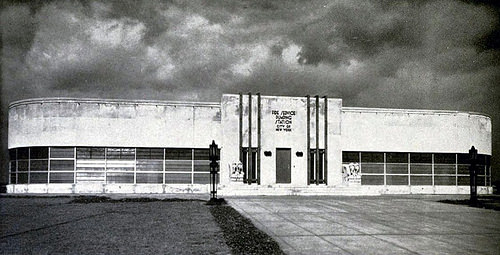
Coney Island Pumping Station designed by architect I.S. Chanin and completed in 1938
Update: September 29, 2015…Will 1938 Art Moderne Gem Become Coney Island’s Only Landmark Outside of Amusement Area? Your last chance to submit public comments to save the long neglected Coney Island Pumping Station designed by Chanin Building architect Irwin Chanin is just three days away.
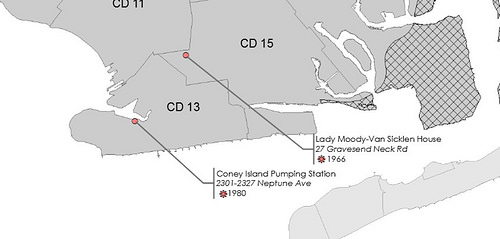
The Coney Island Pumping Station, a long vacant and neglected 1938 art moderne gem built by Chanin Building architect I.S. Chanin on Coney Island Creek is among nearly 100 proposed landmarks set to be dropped en masse from the Landmarks Preservation Commission’s calendar on December 9th. The city-owned building would be the only landmark outside of Coney’s amusement area, which has six landmarks. Gravesend’s privately owned Van Sicklen House, often referred to as Lady Deborah Moody’s House, is also in the group of buildings, all of which were first calendared prior to 2010.
In this morning’s email an Urgent Preservation Alert from the Greenwich Village Society for Historic Preservation (GVSHP) confirmed the news first posted on Friday by Landmarks West and posted a link to the official notice on the LPC’s website.
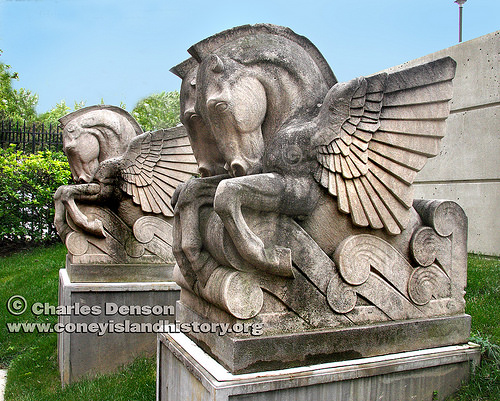
Pegasus statues from the Coney Island Pumping Station were removed to the Brooklyn Museum’s Sculpture Garden for safekeeping in 1980. Photo © Charles Denson
Decommissioned as a fire pumping station in 1976, the long vacant structure on Neptune Avenue is listed as a “non-residential structure with no use” in the database of City-owned property. Nothing ever came of a plan reported by the NY Times in 1990 to spend $23 million to revive the structure to connect two wings of transitional housing for homeless families.
Today, Charles Denson, director of the Coney Island History Project, says the facade can be restored and the building reused. As part of the City’s “How Would You Spend One Million” participatory budgeting program, Denson has already proposed using the property for a “constructed wetland” bio-filter demonstration project on Coney Island Creek. “This project would demonstrate the benefits of natural filtration as a way to clean Coney Island Creek’s storm sewers using natural methods of wastewater treatment.”
“The demonstration project would consist of tanks of Spartina filtering waste water that now flows untreated into Coney Island Creek,” writes Denson, who grew up in the neighborhood and recently released a film on the uncertain future on the Creek. “The project, located on city-owned land behind the old Neptune Avenue pumping station, would be educational, create habitat for wildlife, and help clean a recreational environment that is heavily used by the surrounding Coney Island community. Local schools could work with teachers and scientists to build and operate this small facility.” Machinery for the project would be located inside the building, Denson says.
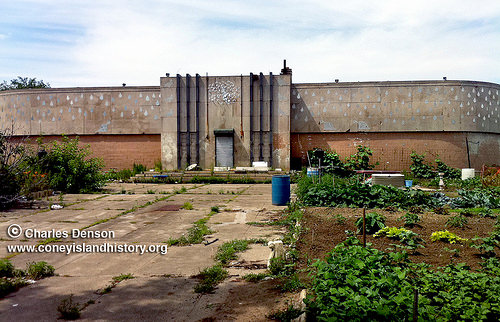
Coney Island Pumping Station, Neptune Avenue. July 18, 2014. Photo © Charles Denson
After being proposed for landmark designation in 1980, the building was to be mothballed and protected for future use, according to a 1981 article in The Society for Commercial Archaeology News Journal. However, the city proved unable to protect the building from vandals who removed the nickel silver, steel, aluminum and granite trim, and chiseled away at the facade and the winged horses at the building’s entrance. “In an attempt to protect the sculpture from further vandalism, Charles Savage, director of the Commission’s salvage program, managed to have them removed to the Brooklyn Museum for safekeeping. Local press applauded the preservation of this portion of the so-called ‘off-beat Coney Island landmark.'”
According to today’s alert from GVSHP’s Andrew Berman:
The New York City Landmarks Preservation Commission (LPC) has just scheduled a vote for next Tuesday, December 9th on a mass ‘de-calendaring’ of nearly one hundred buildings and structures throughout the five boroughs. With no testimony from the public allowed and without even consideration of the individual merits of each site, the Commission will vote to ‘de-calendar’ or remove scores of buildings from its calendar for official consideration as individual landmarks
When a site has been “calendared” by the LPC, it is officially under consideration for landmark status, and the Commission can hold a public hearing and/or vote to designate the structure. Perhaps more importantly, calendaring means that no demolition, construction, or alteration permits can be granted for a site without first notifying the LPC and allowing them up to forty days to designate the structure or negotiate a change or withdrawal of the permit applications. Once de-calendared, the Commission gets no notification of such permit applications and has no power to delay their issuance, allowing these buildings to be altered or demolished at will.
GVSHP has called upon the LPC to drop the proposed mass de-calendaring, and to instead consider the individual merits of each of the structures in question through an open public hearing and review process (read letter HERE).
HOW TO HELP:
Write to the Mayor and the Chair of the LPC right away and urge them to drop the proposed de-calendaring>>
Hold Tuesday, December 9th on your calendar — if the City does not drop the proposed de-calendaring, we will need you to join us and other preservationists on the day of the vote to protest this egregious action.
A map of the nearly 100 structures throughout the city set to be de-calendered is HERE.

UPDATE December 5, 2014:
An email this morning from the Greenwich Village Society for Historic Preservation with the good news! BREAKING: Facing Mass Opposition City Drops Plan For De-Calendaring of Nearly 100 Potential Landmarks! Thanks to Andrew Berman of GVSHP and other advocacy groups for their leadership on this issue. We hope there is a silver lining to this and the buildings that were calendered long ago and forgotten, like the Coney Island Pumping Station, finally get the consideration they deserve.
On the website of the Landmarks Preservation Commission the following notice was posted: STATEMENT FROM CHAIR MEENAKSHI SRINIVASAN RE: PROPOSAL TO ADDRESS AGENCY BACKLOG… Agency will take additional time to consider its proposal to issue “no action” letters to items that have been on LPC’s calendar for five years or more with no action taken by the Commission. “In response to community requests for more time, the Commission has decided not to proceed on December 9th and take a pause to continue to consider feedback on aspects of the proposal. We remain committed to making the Landmarks Commission more effective and responsive in its work, and to clearing a backlog of items that have sat idle for decades so that we can focus on today’s preservation opportunities.”




 Amusing the Zillion