Feeds:
Posts
Comments

Archive for the ‘history’ Category

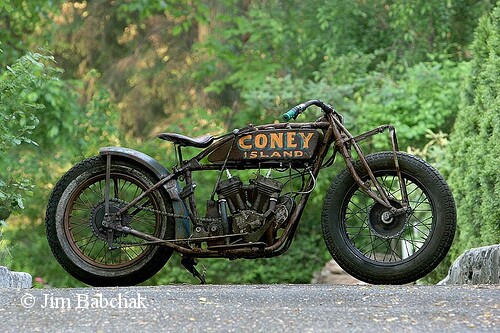
1924 Indian Scout, 30.50 cu in, original Coney Island Motordrome bike! Runs excellent! Jim Babchak Collection. $22,900

1924 Indian Scout, 30.50 cu in, original Coney Island Motordrome bike! Runs excellent! Jim Babchak Collection. $22,900

This photo of an antique motorcycle offered for sale on Kiwi Bike’s blog caught our eye because of its Coney Island provenance. “1924 Indian Scout; 30.50 cu in, original Coney Island Motodrome bike! Same owner last 30 years. Runs excellent! Gone thru by George Yarocki, noted Indian Scout expert. Own a piece of classic American History 22,999.00”

If the bike could speak, what would it say? ATZ talked with the bike’s owner, Jim Babchak, who happens to be the Classics Editor at American Iron Magazine and a longtime member of the Antique Motorcycle Club of America. Turns out he acquired this rare souvenir of the Coney Island Motordrome in the early ’80s. “I was bartending downtown when I saw an ad in the newspaper for an Indian motorcycle,” says Babchak. In order to beat out the competition, he made an appointment to meet the owner at 3 a.m. As soon as the bar closed, he rushed to Avenue U in Brooklyn. Babchak says the seller was an old guy, though not a motordrome rider. He remained mysterious about how he came by the two Indian Scouts he’d kept in his basement for more than 25 years! “I bought one,” recalls Babchak. “He allowed me to buy the second one a few years later.”
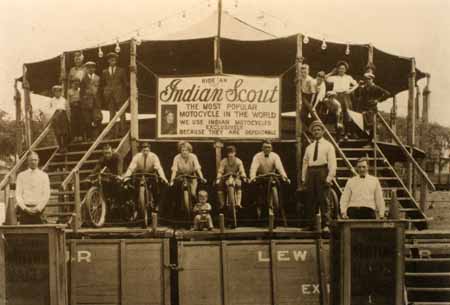
Wall of Death: Indian Scout--The Most Popular Motocycle in the World. Location Unknown.  Photo via The Selvedge Yard

Wall of Death: Indian Scout--The Most Popular Motocycle in the World. Location Unknown. Photo via The Selvedge Yard

Babchak brought the bike to master mechanic George Yarocki who got it running for the first time in decades. Condition report: “The frame is reinforced. It had crashed many times. The handlebars have been broken and repaired. Tires are skinned on one side. And the Indian gas tanks are squared.” Babchak says he owns a half-dozen bikes and usually rides a 1941 Harley Davidson three-wheeler, but occasionally takes the Indian for a spin in his neighborhood. He isn’t especially eager to sell it either. He just wanted to put it out there for people to see.

“Indian Scouts were New York City police bikes,” explains Babchak. The story goes that the reason Indians have a left-hand throttle was so that the motor cop could draw a pistol with his right hand. Harleys have a right-hand throttle, says Babchak, who thinks the Indian probably had a first life as a New York City police bike and was later acquired by the motordrome.
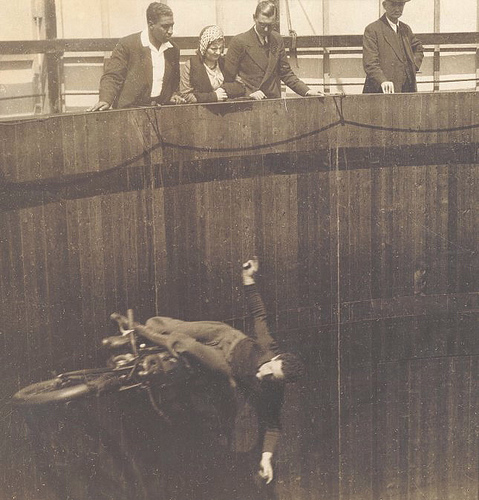
Curly Lou Cody Riding the Wall of Death.  Photo via Thrillarena.com

Curly Lou Cody Riding the Wall of Death. Photo via Thrillarena.com

Where was the Coney Island Motordrome? ATZ did a little research on the web about motordromes in Coney Island. Not surprisingly, there have been a number of them over the years. Perhaps the bike came from the motordrome built in 1937 in Luna Park by Curly Lee Cody and his brother Cyclone Jack. The two men had a Wall of Death show with touring carnivals and had motor dromes built to their specifications. A reminiscence by one of their crew is posted on Sam Morgan’s marvelous Thrillarena site

My job was to gun the engine of a display machine without a muffler and rear wheel to bring people in from all over Luna Park to see the show. I still remember stretching to reach the grips while gunning the engine. Cyclone Jake married a gal with brilliant red hair. Red actually got into the show. The 3 of them would ride the wall together criss-crossing and do amazing stunts. The one that I remember very vividly is when another uncle would hold me inside the motordrome and Lou would come up and eventually slap my hand every time he went around for a few minutes. The show, as all of Luna Park, became more and more deserted as people went to war or worked long hours after Pearl Harbor and the show became a victim of WW II. It was a good life, lots of broken bones when bikes didn’t have enough centrifigal force and came down sometimes on top of the rider(s) but it was a great life. I recently saw a few 1923 and 1929 Indians in the NHRA museum in Pomona, California and was hit hard by the old time memories.

An earlier Coney drome, on the Boardwalk at 23rd Street, made headlines in July 1932 when its oil-soaked wall and gas tanks burst into flames after some boys started a bonfire under the Boardwalk. The blaze spread quickly, destroying blocks of wooden bathhouses and bungalows. The fire caused an estimated $2 to $3 million dollars worth of property damage. The next year, another Coney Island fire destroyed yet another motordrome.

But we were surprised to learn that the popular Wall of Death attraction of our carnival childhood can trace its origins back to a drome which debuted in Coney Island in 1911. The New York Times described it as “the biggest single sensation at Luna Park.” The smaller, portable carnival dromes were inspired by the huge wooden board racetracks for professional motorcycle and auto racing which were popular in the early 1900s. Among the board racetracks were Brooklyn’s Brighton Motordrome (1912) and the Sheepshead Bay Speedway (1919).
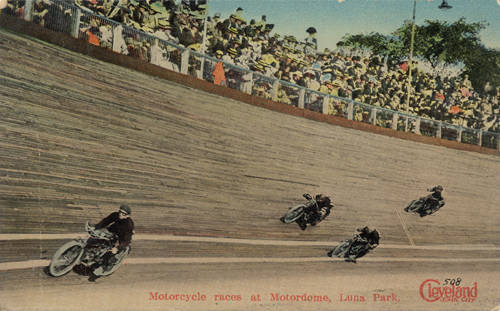
Inspiration for the Wall of Death: Cleveland's Luna Park opened in 1906. Its Motordrome was a wood-planked motorcycle speedway. Postcard via The Cool History of Cleveland

Inspiration for the Wall of Death: Cleveland's Luna Park opened in 1906. Its Motordrome was one of the wood-planked motorcycle speedways that were popular in the early 1900s. Postcard via The Cool History of Cleveland

According to the Times, the saucer-shaped drome in Coney Island’s Luna PArk was 85 feet across the top and half that at the bottom and banked at 65 degrees. It featured two racing automobiles attempting to pass each other. “It usually takes about 50 laps for one to do this, and when it is done, the race is over–for twenty minutes–when it begins again.” By the next season, a competing motordrome with racing motorcycles had opened across Surf Avenue on the site of Dreamland Park, which had burned down in 1911. We found a clip about a rider in the Dreamland drome who was mortally wounded after crashing through the top of the track. R.I.P. William Mullen aka Dare Devil Bill, Age 22.
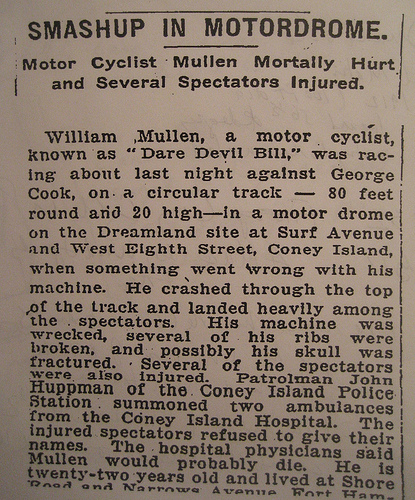
Smashup in Coney Island Motordrome. New York Times, May 19, 1912

Smashup in Coney Island Motordrome. New York Times, May 19, 1912

Share

Related posts on ATZ...

September 9, 2010: Thor’s Coney Island: Faber’s Fascination Goes Dark After 50 Years

February 26, 2010: Made in Brooklyn: The World’s Only Jet-Powered Merry-Go-Round

February 25, 2010: Happy Belated Birthday to Coney Island’s William F Mangels

November 16 2009: Rare & Vintage: Coney Island Sideshow Banner by Dan Casola

Read Full Post »

In celebration of the birthday of Harpo Marx, who made his stage debut in Coney Island’s soon-to-be-demolished Henderson Music Hall in 1908, we’ve assembled some of our fave scenes from Harpo’s film and television career. Happy Birthday to Harpo (born November 23, 1888) and Happy Thanksgiving to all of our readers. Enjoy!

When Harpo appeared on “I’ve Got A Secret” in 1961 to plug his new memoir Harpo Speaks!, he acted out the answers to interview questions from host Garry Moore while the panelists, including Johnny Carson, try to figure out what he’s miming.

As for Harpo’s debut in show business on June 1, 1908, here’s what he had to say about it in Harpo Speaks

It was not until Minnie got me on the El that the awful truth of her mission struck me, like a bolt of lightning out of a clear blue sky. We were headed for Coney Island. I was being shanghaied. I was being shanghaied to join Groucho, Gummo and Lou Levy. On a stage. Singing. In front of people.

On the train, Minnie screened me with a newspaper, while I changed into a white duck suit, my costume. At the same time she tried to teach me the words to “Darling Nelly Grey.” I was too weak with dread to protest. My mind went blank. I couldn’t possibly learn the song before we got to Coney Island.

As one of “The Four Nightingales” performing at Henderson’s, Harpo had such a bad case of stage fright that he wet his pants…

It was probably the most wretched debut in the history of show business.

Nobody could hear me sing that night in the quartet at Henderson’s. It was all I could do to open my mouth at approximately the same time that Groucho, Lou and Gummo opened their mouths. But I sang, a voiceless swan song. I sang farewell to the streets of the East side, to hurtling and hopping trolleys and swindling ticket choppers, farewell to happy-go-lucky hired today and fired tomorrow wandering from job to job…Like it or not I was in show business for the rest of my days.

Harpo’s Place, a website lovingly put together by Harpo’s son, Bill Marx, features a wonderful collection of family photos and memorabilia. From a list of the Harpo Marx Family Rules–we like #8: “If things get too much for you and you feel the whole world’s against you, go stand on your head. If you can think of anything crazier to do, do it.”

As his father’s “prop man” for 12 years, Bill Marx has a complete list of the unusual items that were part of Harpo’s repertoire, including knives that come out of a coat (and the coat), a clarinet (with mechanical bubble machine and tube), and signs for sewing on the singers’ rear ends! In this BBC clip, a rare voice recording of Harpo speaking is played and Bill explains why Harpo never spoke in film or TV appearances.

In Coney Island, preservationists have tried to save the historic Henderson Music Hall where music and vaudeville acts such as the Marx Brothers, Al Jolson and Sophie Tucker performed. But the building failed to win consideration for landmark status since it has been altered extensively. The City’s Landmarks Preservation Commission also rejected an application by Coney Island USA, Save Coney Island, the Coney Island History Project, the Historic Districts Council and the New York City Landmarks Conservancy to create a historic district. Ironically, the New York State Office of Parks, Recreation and Historic Preservation wrote that “the historic core of Coney Island appears to meet the criteria for listing to the Registers as a historic district.”

There’s also the unfortunate fact that the Henderson is owned by real estate speculator Joe Sitt of Thor Equities and occupies a prime site at the corner of Surf and Stillwell that was rezoned for a high rise hotel in 2009. A demolition permit has been issued and the former music hall is expected to be demolished soon, though there are no immediate plans to build a hotel.

At the same time, the 93rd Street Beautification Committee has been advocating for the preservation of “Marx Brothers Place” in Manhattan. The grassroots group wants the City to extend the Carnegie Hill Historic District one block to include the Marx brothers childhood home at 179 East 93rd Street. For info, visit their blog or e-mail 93rdst.beautification[AT]gmail.com.

Share

Related posts on ATZ…

September 27, 2010: Video: The Museum of Wax by Charles Ludlam

September 20, 2010: Movie Monday: Teaser Trailers from the Coney Island Film Festival

April 29, 2010: Photo of the Day: Interior of Coney Island’s Doomed Henderson Music Hall

February 26, 2010: Happy Belated Birthday to Coney Island’s William F Mangels

Read Full Post »

Thor Equities phone # dwarfs Shoot out the Star. Jan 1, 2009.  Photo © Tricia Vita/me-myself-i via flickr

Thor Equities phone # dwarfs Shoot out the Star on Henderson Bldg. Jan 1, 2009. Photo © Tricia Vita/me-myself-i via flickr

News to us: Joe Sitt, CEO of Thor Equities, the real estate speculator whose destruction of four historic buildings in Coney Island is currently underway, is into history after all! Today we learned that Sitt is president of a history museum. The Sephardic Heritage Museum, incorporated as a “non-profit or religious entity” in Delaware in 2005, had nearly $3 million in assets according to last year’s filing. The address listed for the museum is the same as Thor Equities office. The museum is not yet open to the public, we were told by a gentleman who answered the phone at a Lakeland, New Jersey number listed on the web. The filing states: “When the museum opens, it will maintain and publicly display objects of historical, cultural and religious significance to persons with Sephardic Jewish descent and their heritage.”

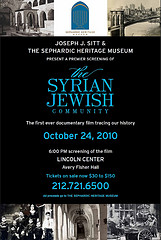
ATZ was tipped off to the existence of the fledgling museum via an invitation to a film screening at Lincoln Center that was forwarded by a reader. The invite says: Joseph J. Sitt & The Sephardic Heritage Museum present a premier screening of “The Syrian Jewish Community.” The first ever documentary film tracing our history. October 24, 2010. 6:00 PM screening of the film. LINCOLN CENTER, Avery Fisher Hall. Tickets on sale now $30 to $150. All proceeds go to The Sephardic Heritage Museum. All tickets are tax deductible.
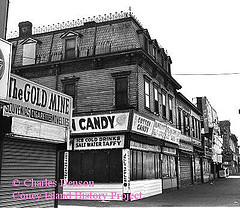
Founding a museum and supporting a documentary film devoted to one’s heritage are commendable efforts. We just wish Joe Sitt showed a similar interest in the historical and cultural significance of Coney Island’s amusement district and the properties that he owns there. The Grashorn Building, Coney Island’s oldest structure, built in the 1880s; the 1923 Bank of Coney Island, the 1903 Shore Hotel and the former Henderson Music Hall have a date with the wrecking ball.

Grashorn Building in 1969. Photo © Charles Denson via Coney Island History Project

Coney Island's Oldest: Built in 1880s, Grashorn Building in 1969. Photo © Charles Denson via Coney Island History Project

In “Four Coney Island Buildings to Fall,” Friday’s Story of the Day on the National Trust for Historic Preservation’s website, Thor spokesman Stefan Friedman said, “These are ramshackle structures, eyesores.” Historian Charles Denson countered by citing the Parachute Jump, which had been described by detractors as “an eyesore” and “dangerous” in the years prior to its rehab and landmark designation. In the article, Juan Rivero of Save Coney Island noted that an engineer has offered to assess the buildings’ structural integrity free of charge, if Thor Equities is willing to grant access to the buildings. How about it Joey Coney Island?

Related posts on ATZ…

December 27, 2010: Video:Tribute to the Henderson Theater by Charles Denson

September 12, 2010: Video: Coney Island’s Faber’s Fascination by Charles Denson

April 21, 2010: Thor’s Coney Island: Tattered Tents, Deathwatch for Historic Buildings

March 3, 2010: Thor’s Coney Island: What Stillwell Looked Like Before Joe Sitt

Read Full Post »

« Newer Posts - Older Posts »