Feeds:
Posts
Comments

Archive for the ‘Real Estate’ Category

Beachfront Condos

Beachfront Condos Under Construction on Boardwalk at 32nd St, Coney Island. Photo © Bruce Handy/Pablo 57 via Android

The first private beachfront condominiums to be built on the Coney Island Boardwalk are under construction at West 32nd Street and are expected to be completed this summer. The four-story building will have 11 units including 1, 2 and 3 bedroom apartments, each with its own parking stall. Marina Krasnova of New Vision told ATZ that sales prices range from $685,000 for a one-bedroom to $1.55 million for the penthouse.

Located in the West End of Coney Island, across the street from the NYC Housing Authority’s Coney Island Houses, this new construction is a harbinger of more beachfront residential to come. The rezoning plan approved by the City Council in 2009 put 26 high rise residential towers and 5,000 new units of housing in Coney Island, including beachfront condos on Taconic Investment Partners 5.5 blocks of vacant land just west of MCU Park (West 20th Street).

We think it is the future beachfront residential, which Taconic has valued at $300-$900 per square foot, that is driving the City’s plan to gentrify the Boardwalk and make it into a year-round destination with upscale restaurants and bars.

Beachfront Condos Under Construction on Boardwalk at 32nd St, Coney Island. Photo © Bruce Handy/Coney Island Photo Diary via flickr

Coney Island History Project director Charles Denson, who grew up in Coney Island Houses, tells ATZ that the lot on West 32nd Street has been vacant since 1982. “It was the site of Sam’s Knishes and the Lincoln Baths,” said Denson, whose book Coney Island: Lost and Found combines a history of land use in his neighborhood and boyhood memoir. “Sam’s had the best cherry cheese knishes in the world and the Lincoln Baths go back over 110 years.” On the History Project’s blog “Ask Mr Coney Island,” Denson notes that the Lincoln Baths, along with the Washington Baths (W 21st St), Roosevelt Baths (W 30th St) and Jefferson Baths (W 33rd St) were Coney Island’s “presidential bathhouses.”

“The bathhouses were where people rented lockers and changed from street clothes to swim suits. You could also rent swimsuits and beach chairs and umbrellas,” writes Denson. “They were very social places and generations of families and friends from the same neighborhoods patronized the same bathhouses for years until the last one (Brighton Beach Baths) was demolished in the early 1990s.”
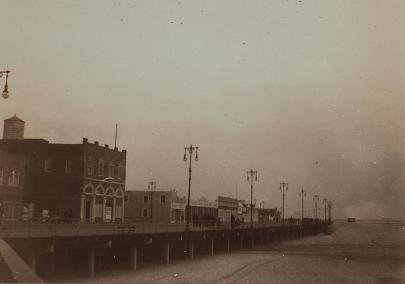
Coney Island Boardwalk

Coney Island Boardwalk east of West 33rd Street showing the Lincoln Baths in the foreground, 1924. Eugene L. Armbruster Collection, New York Public Library

How did it happen that land once occupied by bathhouses patronized by working class New Yorkers is destined to become luxury beachfront apartments? The Washington Baths site, which Thor Equities bought from Horace Bullard for $13 million, was flipped to Taconic for an exorbitant $90 million because both parties were sure the City would rezone it for residential.

Taconic Investment Partners plans to build a glittering city of 2,500 apartments and 200,000 square feet of retail west and north of MCU Park. According to Taconic’s website: “The North Venture consists of three city blocks on the North side of Surf Avenue totaling nearly 109,000 square feet. One block from the beach, these parcels include vacant or under-improved land. Coney Island South Venture encompasses 5.5 acres on the south side of Surf Avenue, interspersed over four blocks along the beachfront, and is also comprised of vacant or under-improved land totaling nearly 240,000 square feet.”

As Taconic CEO William Bendit told Eliot Brown of the New York Observer in an interview in 2009: “What attracted us to Coney Island was the fact that it’s vacant land—we didn’t have to dispossess anybody, relocate anybody. And it’s the beachfront. How much beachfront land is there in New York City? Not only that, but beachfront land that’s accessible to the subway. So, if you think about it, how many young people, or anybody, for that matter, would like to commute into New York or Brooklyn, and go home at night and live on the beach?”

What would it take to make you move to the new Coney Island?

Coney Island Aerial: Detail of Conceptual Rendering. CIDC Press Kit

Coney Island Aerial: Detail of Conceptual Rendering Shows Residential Towers West and North of MCU Park. CIDC Press Kit

Share

Related posts on ATZ…

December 20, 2011: Update: Coney Island’s 1st Private Beachfront Condos on Boardwalk

January 11, 2010: Steeplechase Pool, Zip Coaster Sites to Be De-Mapped for Housing

July 27, 2009: Tall, Skinny & Destined to Kill Coney Island: High Rises on South Side of Surf
Read Full Post »

Coney Island Colorado

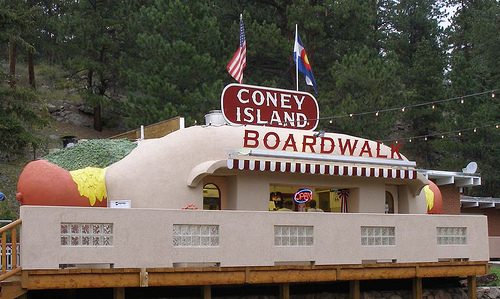
Coney Island Colorado Diner, Bailey, CO. Photo © RoadsideArchitecture.com

November 8, 2015: The Coney Island Boardwalk Hot Dog restaurant in Bailey, Colorado, is up for sale again! The asking price is triple what it was in 2011. Scroll down for update…

Hey, wanna buy the Coney Island Boardwalk? The historic hot-dog shaped “Coney Island Boardwalk” diner, in Bailey, Colorado, is being offered for sale by its owner. It’s all yours, including stucco bun and mustard and relish toppings, for just $499K. According to the listing, the bun is 35 feet long and the hot dog 42 feet. Made of concrete-and-steel, this fine example of novelty architecture weighs a hefty 18 tons. But the buyer will have to move the 1960’s eatery from its current location on the South Platte River about 30 miles southwest of Denver.

Inside the Hot Dog

Inside the Hot Dog. Photo © themickeyd/RonMcdonald via flickr

“Truly my dream was to have a beautiful location,” said Ron Aigner, the diner’s owner, in a phone interview with ATZ. “Now I can’t even walk the dog.” Left disabled with a broken back after an altercation with local authorities, Aigner closed the diner and advertised it for sale. Aigner told ATZ he wouldn’t mind if somebody bought the diner and moved it from Colorado to the original Coney Island in Brooklyn, New York! Now that would be an unusual move: New York City has been losing its historic diners since the Moondance was sold to new owners in Wyoming and the Cheyenne went to Alabama.

Once Coloradans find out about the listing, we think they’ll rally to save their Coney Island, which was built in Denver in 1966. Its designer Marcus Shannon of Lakewood, Colorado, planned a chain of hot dog diners and filed a patent for the design in 1965. The eatery was originally located on West Colfax in Denver. Since 1970, the Coney Island Boardwalk has been on scenic US Highway 285, first in Aspen Park and then in Bailey.

The building has been hailed as “the best example of roadside architecture in the state” by Thomas J. Noel, a Professor of History and Director of Public History, Preservation & Colorado Studies at the University of Colorado. In reply to ATZ’s email, Noel (aka “Dr. Colorado”) wrote: “We Coloradans should rally to save one of our greatest culinary landmarks, a most delicious morsel of pop roadside art. Hot Dog! Don’t let the Coney Island die.”

Under the Dog

Under the Dog. Photo © themickeyd/RonMcdonald via flickr

The delightful interior of the hot dog, which was lovingly restored, includes two booths and a diminutive counter with a few stools. “I moved it and renovated it. It does a huge business,” says Aigner, who offered to provide sales figures to prospective buyers. “I put out about 20 to 30 tables for people to sit by the river.” Indeed, restaurant reviewers mention an hour-long wait for a wiener during the busy summer season, though they say it was worth it for the Chicago-style dog. But Aigner says the location was not suited for year-round business: “We’re on the road to Breckinridge. It’s the second busiest highway, but not the ski traffic highway.”

The first photo in this post was taken by our friend RoadsideNut, a New Yorker who has extensively documented America’s roadside architecture on her website. Check out the Burgers and Hot Dogs page, where the Coney Island in Colorado appears along with Top Dog, Giant Burger and other architectural wonders.

UPDATE November 8, 2015:

The Coney Island Boardwalk Hot Dog restaurant in Bailey, Colorado, is up for sale again! According to a local news report, owner Ron Aigner is retiring and has listed the property for $1,495,000. Broker Jim Urban has posted a video tour on YouTube:

UPDATE August 14, 2011:

ATZ is happy to report that the diner reopened for the summer. The person whom we spoke with on the phone was unable to confirm fall/winter hours. Call in advance. A Yelper reports that the elk dogs are terrific. The diner’s address is 10 Old Stagecoach Rd, Bailey, CO 80421. Phone (303) 838-4210.

Before Renovation: The Coney Island Hotdog Stand, seen here in Aspen Park, CO, before it was sold and moved to Bailey, CO in March 2006. August 16, 2005. Photo © mrivorey/Chris Moody via flickr

Share

Related posts on ATZ…

December 4, 2010: Artifact of the Day: Vintage Coffee Cup from Childs Restaurant

November 21, 2010: Goodbye (Or Maybe Not?) to My Coney Island Equivalent of Proust’s Madeleine

October 17, 2010: Coney Island to Get Flying Coaster from Denver’s Elitch Gardens

January 19, 2010: Nathan Slept Here! Coney Island’s Feltman’s Kitchen Set for Demolition

Read Full Post »

Grashorn

Stores for Lease: The Grashorn, Coney's Oldest Building. January 20, 2011. Photo © Bruce Handy/Pablo 57 via flickr

One of Thor Equities’ omnipresent “Stores for Lease” banners went up yesterday on the Grashorn Building. Thanks to Coney Island photographer Bruce Handy for stopping by and taking these photos last evening. The banner caused excitement as peeps realized it meant that Coney Island’s oldest was not going to be demolished after all! Not this season anyway. But will it be leased? We’d really like to hope so, though potential tenants’ efforts to lease the building last year fell through. ATZ knows a couple of people who have already expressed interest. Get your bid in now!

Grashorn

Stores for Lease: The Grashorn, Coney's Oldest Building. January 20, 2011. Photo © Bruce Handy/Pablo 57 via flickr

For the record, Thor Equities never got a demolition permit for the Grashorn. ATZ first noticed this in August when the demo permits for the now demolished Bank of Coney Island, the Shore Hotel and the Henderson Music Hall were first issued. We never mentioned it because by then not calling attention to the Grashorn seemed the best way to protect the building.

Why was Coney Island’s oldest building granted a reprieve? Unlike the Bank of Coney and the Henderson, the Grashorn parcel at Surf Ave and Jones Walk was not rezoned for a 30-story high rise hotel. There’s also the fact that the building is just a few doors away from Luna Park’s entrance. And there’s also the fact the City owns the east side of Jones Walk and leases it to game concessions. The demolition of the Grashorn would have created a desolate empty lot near the City’s showcase amusement park and killed business on the Walk. Hey maybe the Mayor said to Joe, no demo?

In Coney Island: Lost and Found, historian Charles Denson writes that the building at 1104 Surf dates back to the 1880’s and the Grashorn hardware store served Coney Island’s amusement businesses for more than 60 years: “The clapboard façade, dormers, cast iron resting, chimneys and fish-scale shingles were removed when the building was renovated in the 1980s but the mansard roof retains its shape.”

Grashorn Building in 1969. Photo © Charles Denson via Coney Island History Project

Grashorn Building in 1969. Photo © Charles Denson via Coney Island History Project

Share

Related posts on ATZ…

January 1, 2011: Amusing the Zillion’s Top 10 Coney Island News Stories of 2010

December 29, 2010: New Restaurant Building Next to Coney Island’s Stillwell Terminal

December 23, 2010: Coney Island Christmas Wish List: $12M Shore Theater

December 10, 2010: Displaced Queens Flea Vendors Eye Coney Island’s Vacant Lots

Read Full Post »

« Newer Posts - Older Posts »