Feeds:
Posts
Comments

Posts Tagged ‘Coney Island’

Circus mermaids and freaks, Coney Island sideshows, and a traveling circus and carnival take center stage in this trio of literary novels that we read over the summer. Wondrous and horrific by turn, these stories will have you turning their pages well past the witching hour.

The Book of Speculation by Erika Swyler. St. Martin’s Press, 2015. Hardcover, $26.99.

The Book of SpeculationErika Swyler’s The Book of Speculation is a suspenseful novel that combines some of our favorite things — traveling shows, sideshow performers, mermaids, family secrets and rare books. The rare book is the 17th century log of a traveling circus which the narrator receives in the mail from a stranger along with a mysterious message: “A name inside it–Verona Bonn–led me to believe it might be of interest to your family.” The women in Simon Watson’s family, including his mother and grandmother, were circus mermaids who drowned, always on July 24. The novel alternates between the magical tale of Simon’s ancestors documented in the logbook and his present life on Long Island, where he is in danger of losing both his job as a librarian and his family’s historic home. As the date of his mother’s death approaches, Simon becomes convinced that his sister, who ran off with a carnival, is doomed to drown as well. Can the revelation of a family secret save them both?

The Museum of Extraordinary Things by Alice Hoffman. Scribner, 2014. Hardcover, $27.99; Paperback $16.00.
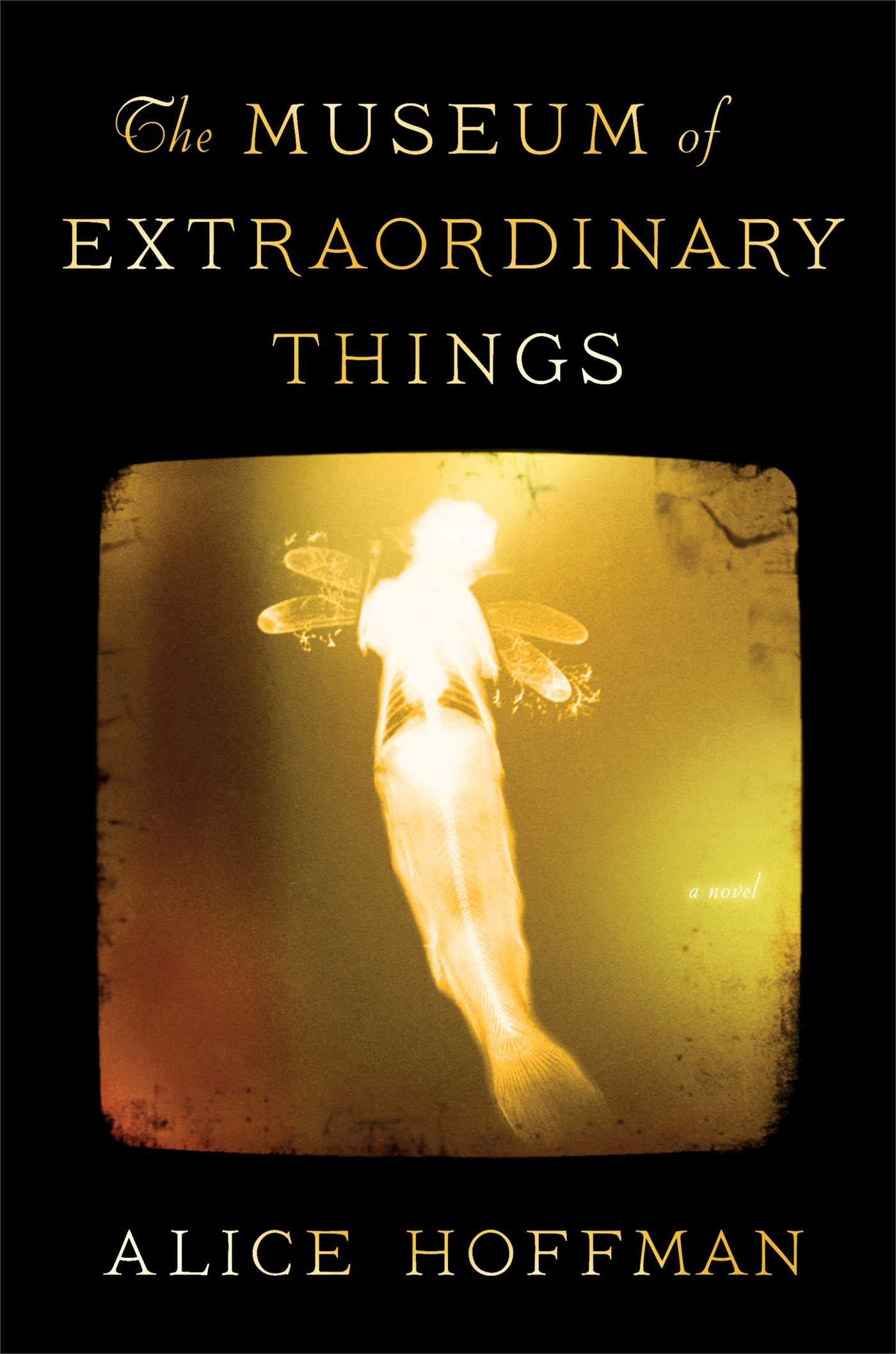
Museum of Extraordinary ThingsCoralie, the enchanting heroine of Alice Hoffman’s The Museum of Extraordinary Things, was born with webs between her fingers. Pressed to perform as a “human mermaid” in her father’s museum of freaks and curiosities in early 20th century Coney Island, she escapes after hours by swimming the Hudson River. Sightings of “a sea monster” become a tabloid mystery. Coralie’s story unfolds parallel with that of Eddie Cohen, a Jewish immigrant living on the Lower East Side who works as a newspaper photographer and fishes the river for his supper. It’s clear that their worlds are going to intersect and they are destined to fall in love, but that doesn’t lessen the allure. First published in 2014, Hoffman’s novel was on the New York Times bestseller list and was the Long Island Reads selection for 2015. Set in 1911, the year of both Manhattan’s Triangle Shirtwaist Factory Fire and Coney Island’s Dreamland Fire, the story has an authentic ring to it. Coney Island History Project director Charles Denson was among the early readers of the manuscript.

Church of Marvels by Leslie Parry. Ecco/HarperCollins, 2015. Hardcover, $26.99.
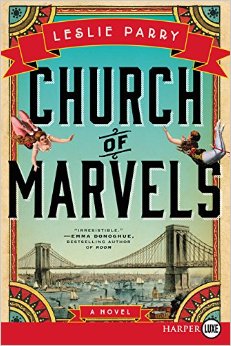
Church of MarvelsThe Church of Marvels of the novel’s title is an 1890’s Coney Island sideshow, but the sideshow has burned to the ground and its proprietor Friendship Willingbird Church is dead before the book begins. Her twin daughters Belle, a beautiful contortionist and sword swallower, has fled to Manhattan, while Odile, who was born with a curvature of the spine, struggles to make a living as the Target Girl on Coney’s Wheel of Death. Initially, we were disappointed the novel did not have more scenes set in Coney Island or the sideshow, as we had anticipated. Leslie Parry’s exquisite prose and the surprising twists and turns of the narrative won us over. Odile’s quest to find her missing sister takes us inside the lunatic asylum on Blackwell’s Island and the tenements and opium dens of the Lower East Side before circling back home to Coney Island.

Related posts on ATZ…

May 17, 2015: Summer Reading: Undertow by Michael Buckley

December 1, 2014: Autumn Reading: Ward Hall – King of the Sideshow!

November 22, 2014: Autumn Reading: The Brooklyn Theatre Index of Coney Island, Brighton Beach & Manhattan Beach

November 10, 2014: Autumn Reading: The Lost Tribe of Coney Island
Read Full Post »

Ghost Hole

12th Street Amusements’ Ghost Hole is smack dab in the path of the City’s proposed extension of Wonder Wheel Way. October 11, 2015. Photo © Tricia Vita

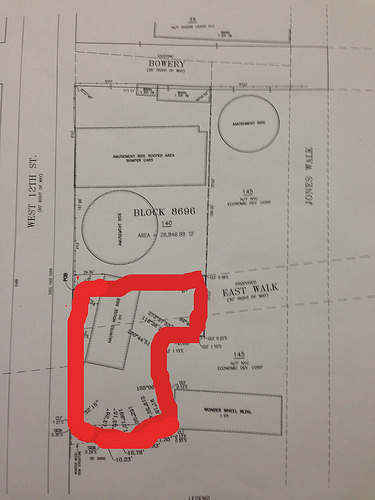
At Monday’s public hearing on the City’s controversial plan to use eminent domain to acquire six privately owned lots for “the revitalization of Coney Island,” drawings show 12th Street Amusements’ Ghost Hole ride on “Block 8696, parts of lot 140” destined for condemnation. The land to the right of the ride, where a longtime Mom and Pop sublease property to operate a High Striker, is also on the part of the lot to be seized by the City. “There are no proposed alternative locations,” the public notice for the hearing published in the NY Post sternly warns.

Block 8696 parts of lot 140

Block 8696, parts of lot 140. the area marked in red is to be taken by eminent domain. October 19, 2015

The reason for the acquisitions was revealed: “Certain replacement parkland” is needed because of “the de-mapping of existing parkland,” stated the Parks Department attorney who ran the hearing. He did not explicitly say which parkland would be demapped, and since “this is not a question and answer forum” (he said twice), no questions were answered. However, it is published information and old news dating back to the Coney Island Rezoning of 2009, except that most people either forgot or never knew that the MCU parking lot, which is parkland owned by the City, is to be de-mapped and sold to a developer. What for? The construction of residential towers with height limits in the range of the Parachute Jump.

Among those who spoke out against it at those long ago rezoning hearings was preservationist Christabel Gough of the Society for the Architecture of the City, who said “In Paris, the Eiffel Tower is framed by parkland. Why is that impossible here?” Refresh your memory by looking at the City’s renderings from 2007. In order to de-map parkland, the State requires that it be replaced with parkland of equal acreage and the City must apply to the State for alienation legislation. However, with the Bloomberg administration’s zoning nearly 6 years ago and a new Mayor who ran as the anti-Bloomberg in place who knew the plan was still a go?

Coney Island Aerial: Detail of Conceptual Rendering. CIDC Press Kit, 2007.

Coney Island Aerial: Detail of Conceptual Rendering Shows Residential Towers West and North of Keyspan Park, now MCU Park. CIDC Press Kit, 2007

As we wrote in “Steeplechase Pool, Zip Coaster Sites to Be De-Mapped for Housing” (January 11, 2010)

It’s a shame that part of the City’s Steeplechase property is set to become a residential enclave with million dollar views instead of additional acreage for Coney Island’s new amusement park.The fact that the Giuliani administration paved over Paradise–part of the Steeplechase Park site–to allow parkland to be turned into the Keyspan parking lot is bad enough (nod to Joni Mitchell’s “Big Yellow Taxi”). Now the Bloomberg administration is asking the state legislature to “alienate” and de-map the parkland/parking lot so it can be sold to a private developer to build 1,900 units of housing.

The Brooklyn Cyclones ballpark was built on the site of Steeplechase’s Pavilion of Fun, but the ballpark is a recreational use and helped revitalize Coney Island when it opened in 2001. A mass of apartment towers on the edge of a dwarfed amusement area is another story, though the City insists 5,000 units of housing is a necessary component of their plan to revitalize Coney Island.

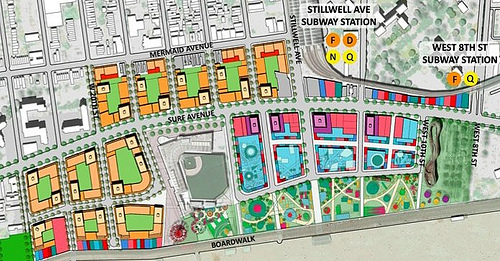
Detail of CIDC Map of of Coney Island Redevelopment Plan.  Salmon and cream color denote residential and residential towers north and west of MCU Park

Detail of CIDC Map of of Coney Island Redevelopment Plan. Salmon and cream color denote residential and residential towers north and west of MCU Park, 2007

News reports prior to Monday’s hearing focused on the acquisition of long vacant land such as the former Thunderbolt lot, but the land grab is not about punishing property owners for keeping their holdings vacant. If it were, Thor Equities’ blighted lot on Surf Avenue and West 12th Street, among others, and Bullard’s Shore Theater, vacant for 40 years, would also be on the list of properties to be taken by condemnation.

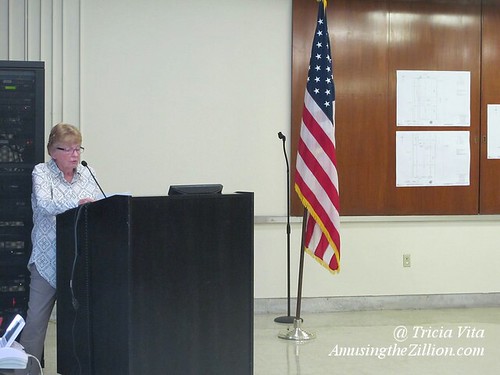
As we already noted, the proposed acquisition includes property currently and historically used for amusement attractions. “Block 8696, parts of lot 140” is owned by the Murray family and has been used for amusement rides for over 100 years, Carol Murray said in her comments at the hearing. The taking of the land constituted “abuse,” she added. In negotiations with the City’s Economic Development Corporation, she said she is being asked to sell the property to the City, which will then lease a portion of it back to her to operate the amusements that already exist on the spot. “It fails to meet the standards of eminent domain,” she said.

eminent domain hearing

Carol Murray, whose family owns a lot leased to 12th St Amusements that is set to be taken by eminent domain by the City, calls the procedure “abuse” at public hearing. October 19, 2015. Photo © Tricia Vita

While many of our Coney friends have said they’re in the dark about what the City is up to, eminent domain in Coney Island is nothing new. Remember Robert Moses? (ICYMI Read Chapter 5 of Charles Denson’s Coney Island: Lost and Found). Remember the behind the scenes bargaining leading up to the Coney Island Rezoning of 2009? (ICYMI See Amy Nicholson’s film Zipper: Coney Island’s Last Wild Ride). In fact, why write new text when we can recycle old ATZ blog posts that are pertinent once again. As we wrote in “Eminent Domain in Coney Island? Fuhgeddaboutit!” (July 31, 2012):

The Bloomberg administration was right to back off from the idea of taking land by condemnation from Thor Equities and other Coney Island property owners during the rezoning hearings in 2009. Under sharp questioning by City Council land use committee members, the EDC’s Seth Pinsky was forced to admit, “I’m not saying we will use eminent domain, but in fairness to your question, I’m not saying we won’t.” In order to get Council members to agree to vote for the zoning, the EDC instead had to negotiate an agreement to buy property from Thor Equities. At the same time, other property owners were no longer threatened by E.D.

We attended that land use committee hearing too, and left with the impression ED was off the table. But that was the Bloomberg administration. A new administration doesn’t have to follow the playbook of the previous one. Back in the ’60s Fred Trump destroyed Steeplechase Park, one of Coney Island’s most famous amusement parks, confident that he would get to develop the “south side” of Surf. That effort failed. The City rejected Trump’s proposed zoning change to develop Miami-style apartments on the beachfront where they approved them in the rezoning of 2009.

Fred’s son Donald Trump has been in the news recently for saying “eminent domain is wonderful.” No one suggested anything like that at Monday’s hearing. The support was tepid with the exception of Dick Zigun, Coney Island’s self-proclaimed Mayor, who jumped on the ED bandwagon by saying “Finish the job.”

Pamela Pettyjohn of the Coney Island Beautification Project said, “Once you open the door for eminent domain, you can’t close it back. It can be abused. Everyone can be in jeopardy.” Ironically the Supreme Court case of Kelo v the City of New London that makes it possible for the City to condemn privately owned property so that it could be used as part of a “comprehensive redevelopment plan” did not turn out to be for the public good in New London. The seized property is a vacant lot ten years after the court’s decision.

Read Full Post »

Pegasus

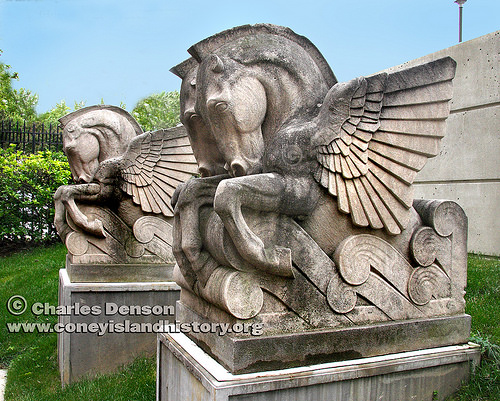
Pegasus statues from the Coney Island Pumping Station were removed to the Brooklyn Museum’s Sculpture Garden for safekeeping in 1980. Photo © Charles Denson via coneyislandhistory.org

Your last chance to submit public comments to save the long neglected Coney Island Pumping Station designed by Chanin Building architect Irwin Chanin is just three days away. [Note: comment period was extended through Octover 22.] The city-owned building on Coney Island Creek would be Coney’s only landmark outside of the amusement area, which has six official city landmarks–The Wonder Wheel, Cyclone and Parachute Jump, the two former Childs Restaurant buildings, and the former Shore Theater.

Prior to the Landmarks Preservation Commmission’s October 8, 2015 public hearing to address a backlog of calendared buildings, the LPC is asking speakers to register in advance and submit written statements by October 1st. The email address for comments is backlog95@lpc.nyc.gov. If you are unable to attend the hearing, your written submissions will be entered into the record and distributed to the Commissioners, according to the LPC’s website. A link to a pdf with information about the hearing, at which 29 buildings are on the agenda, is here.

If the Coney Island Pumping Station wins designation, the Pegasus statues, which were removed to the Brooklyn Museum’s Sculpture Garden for safekeeping 35 years ago, could return in triumph to their Coney Island home. After being proposed for landmark designation in 1980, the building was to be mothballed and protected for future use, according to a 1981 article in The Society for Commercial Archaeology News Journal.

Coney Island Pumping Station

Coney Island Pumping Station designed by architect Irwin S. Chanin, whose works include the Century and Majestic apartment houses and the Chanin Building

However, the city proved unable to protect the building from vandals who removed the nickel silver, steel, aluminum and granite trim, and chiseled away at the facade and the winged horses at the building’s entrance. “In an attempt to protect the sculpture from further vandalism, Charles Savage, director of the Commission’s salvage program, managed to have them removed to the Brooklyn Museum for safekeeping. Local press applauded the preservation of this portion of the so-called ‘off-beat Coney Island landmark.’”

Decommissioned as a fire pumping station in 1976, the long vacant structure is listed as a “non-residential structure with no use” in the database of city-owned property. Nothing ever came of a plan reported by the NY Times in 1990 to spend $23 million to revive the structure to connect two wings of transitional housing for homeless families.

“Numerous proposals have surfaced recently to repurpose the building for community usage including as a Coney Island ferry terminal, ecology center, or museum,” writes Charles Denson on the Coney Island History Project’s blog in a plea to save the building for future generations. “The Art Deco structure was unusual for Coney Island and much different than most municipal structures which were commonly utilitarian and devoid of ornamentation. Chanin commissioned a pair of winged horse sculptures for the entrance to the elliptical limestone and granite Moderne structure, creating a magnificent monument amidst Coney’s ephemeral landscape.”

In addition to submitting your comments to the Landmarks Preservation Commission by October 1st, we urge you to sign and share the Art Deco Society of New York’s petition to landmark the Coney Island Pumping Station, which will be submitted to the Commission.

Coney Island Pumping Station

Coney Island Pumping Station, Neptune Avenue. July 18, 2014. Photo © Charles Denson via coneyislandhistory.org

Related posts on ATZ…

May 4, 2015: Boardwalk Bunco: Milan Expo’s USA Pavilion Has Boardwalk from Coney Island, Brooklyn to Get Plastic & Concrete

April 13, 2015: Video of the Day: Century-Old Forest Park Carousel Awhirl After Off-Season Overhaul

March 11, 2015: In Coney Island, Two Stores and One NYC Landmark Mark 95th Year

November 18, 2014: ATZ’s Guide to Coney Island’s Honorary Walks and Places

Read Full Post »

« Newer Posts - Older Posts »