Feeds:
Posts
Comments
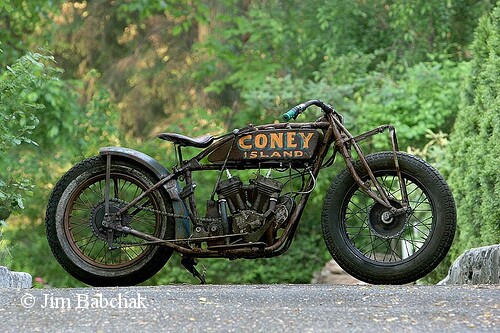
1924 Indian Scout, 30.50 cu in, original Coney Island Motordrome bike! Runs excellent! Jim Babchak Collection. $22,900

1924 Indian Scout, 30.50 cu in, original Coney Island Motordrome bike! Runs excellent! Jim Babchak Collection. $22,900

This photo of an antique motorcycle offered for sale on Kiwi Bike’s blog caught our eye because of its Coney Island provenance. “1924 Indian Scout; 30.50 cu in, original Coney Island Motodrome bike! Same owner last 30 years. Runs excellent! Gone thru by George Yarocki, noted Indian Scout expert. Own a piece of classic American History 22,999.00”

If the bike could speak, what would it say? ATZ talked with the bike’s owner, Jim Babchak, who happens to be the Classics Editor at American Iron Magazine and a longtime member of the Antique Motorcycle Club of America. Turns out he acquired this rare souvenir of the Coney Island Motordrome in the early ’80s. “I was bartending downtown when I saw an ad in the newspaper for an Indian motorcycle,” says Babchak. In order to beat out the competition, he made an appointment to meet the owner at 3 a.m. As soon as the bar closed, he rushed to Avenue U in Brooklyn. Babchak says the seller was an old guy, though not a motordrome rider. He remained mysterious about how he came by the two Indian Scouts he’d kept in his basement for more than 25 years! “I bought one,” recalls Babchak. “He allowed me to buy the second one a few years later.”
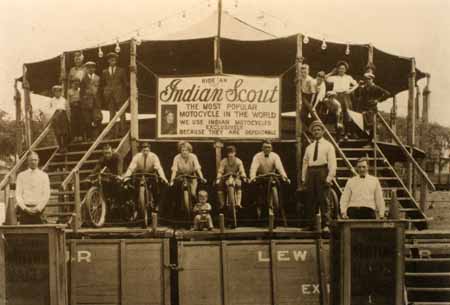
Wall of Death: Indian Scout--The Most Popular Motocycle in the World. Location Unknown.  Photo via The Selvedge Yard

Wall of Death: Indian Scout--The Most Popular Motocycle in the World. Location Unknown. Photo via The Selvedge Yard

Babchak brought the bike to master mechanic George Yarocki who got it running for the first time in decades. Condition report: “The frame is reinforced. It had crashed many times. The handlebars have been broken and repaired. Tires are skinned on one side. And the Indian gas tanks are squared.” Babchak says he owns a half-dozen bikes and usually rides a 1941 Harley Davidson three-wheeler, but occasionally takes the Indian for a spin in his neighborhood. He isn’t especially eager to sell it either. He just wanted to put it out there for people to see.

“Indian Scouts were New York City police bikes,” explains Babchak. The story goes that the reason Indians have a left-hand throttle was so that the motor cop could draw a pistol with his right hand. Harleys have a right-hand throttle, says Babchak, who thinks the Indian probably had a first life as a New York City police bike and was later acquired by the motordrome.
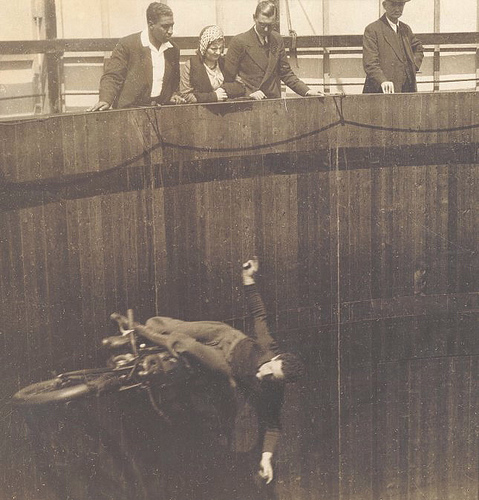
Curly Lou Cody Riding the Wall of Death.  Photo via Thrillarena.com

Curly Lou Cody Riding the Wall of Death. Photo via Thrillarena.com

Where was the Coney Island Motordrome? ATZ did a little research on the web about motordromes in Coney Island. Not surprisingly, there have been a number of them over the years. Perhaps the bike came from the motordrome built in 1937 in Luna Park by Curly Lee Cody and his brother Cyclone Jack. The two men had a Wall of Death show with touring carnivals and had motor dromes built to their specifications. A reminiscence by one of their crew is posted on Sam Morgan’s marvelous Thrillarena site

My job was to gun the engine of a display machine without a muffler and rear wheel to bring people in from all over Luna Park to see the show. I still remember stretching to reach the grips while gunning the engine. Cyclone Jake married a gal with brilliant red hair. Red actually got into the show. The 3 of them would ride the wall together criss-crossing and do amazing stunts. The one that I remember very vividly is when another uncle would hold me inside the motordrome and Lou would come up and eventually slap my hand every time he went around for a few minutes. The show, as all of Luna Park, became more and more deserted as people went to war or worked long hours after Pearl Harbor and the show became a victim of WW II. It was a good life, lots of broken bones when bikes didn’t have enough centrifigal force and came down sometimes on top of the rider(s) but it was a great life. I recently saw a few 1923 and 1929 Indians in the NHRA museum in Pomona, California and was hit hard by the old time memories.

An earlier Coney drome, on the Boardwalk at 23rd Street, made headlines in July 1932 when its oil-soaked wall and gas tanks burst into flames after some boys started a bonfire under the Boardwalk. The blaze spread quickly, destroying blocks of wooden bathhouses and bungalows. The fire caused an estimated $2 to $3 million dollars worth of property damage. The next year, another Coney Island fire destroyed yet another motordrome.

But we were surprised to learn that the popular Wall of Death attraction of our carnival childhood can trace its origins back to a drome which debuted in Coney Island in 1911. The New York Times described it as “the biggest single sensation at Luna Park.” The smaller, portable carnival dromes were inspired by the huge wooden board racetracks for professional motorcycle and auto racing which were popular in the early 1900s. Among the board racetracks were Brooklyn’s Brighton Motordrome (1912) and the Sheepshead Bay Speedway (1919).
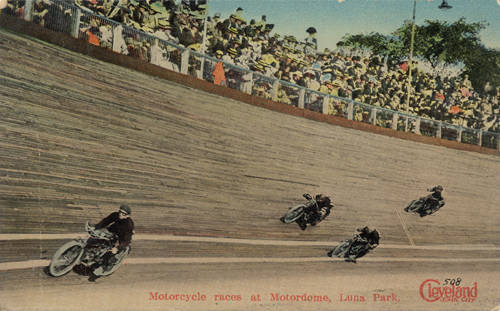
Inspiration for the Wall of Death: Cleveland's Luna Park opened in 1906. Its Motordrome was a wood-planked motorcycle speedway. Postcard via The Cool History of Cleveland

Inspiration for the Wall of Death: Cleveland's Luna Park opened in 1906. Its Motordrome was one of the wood-planked motorcycle speedways that were popular in the early 1900s. Postcard via The Cool History of Cleveland

According to the Times, the saucer-shaped drome in Coney Island’s Luna PArk was 85 feet across the top and half that at the bottom and banked at 65 degrees. It featured two racing automobiles attempting to pass each other. “It usually takes about 50 laps for one to do this, and when it is done, the race is over–for twenty minutes–when it begins again.” By the next season, a competing motordrome with racing motorcycles had opened across Surf Avenue on the site of Dreamland Park, which had burned down in 1911. We found a clip about a rider in the Dreamland drome who was mortally wounded after crashing through the top of the track. R.I.P. William Mullen aka Dare Devil Bill, Age 22.
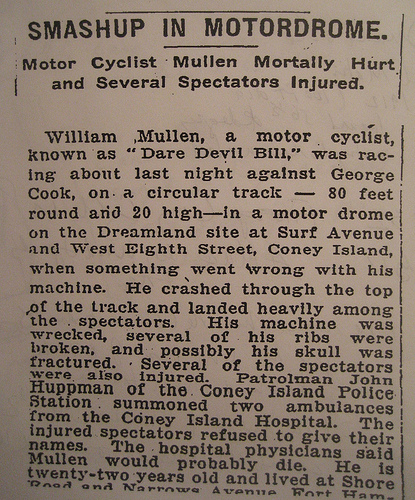
Smashup in Coney Island Motordrome. New York Times, May 19, 1912

Smashup in Coney Island Motordrome. New York Times, May 19, 1912

Share

Related posts on ATZ...

September 9, 2010: Thor’s Coney Island: Faber’s Fascination Goes Dark After 50 Years

February 26, 2010: Made in Brooklyn: The World’s Only Jet-Powered Merry-Go-Round

February 25, 2010: Happy Belated Birthday to Coney Island’s William F Mangels

November 16 2009: Rare & Vintage: Coney Island Sideshow Banner by Dan Casola

After we posted the new vid shot in Deno’s Wonder Wheel Park by the UK’s #1 boy band The Wanted, a reader sent us a link to this blast from the past from another boy band filmed in Coney Island. “I came across a pop video from the ’90s that you might enjoy. The song is pure cheese, but it might be the last music video ever filmed at Astroland,” said the reader.

We did enjoy it. The 1999 tune “Summer Girls” by LFO (Lyte Funkie Ones) takes us back to happier days on the Boardwalk, when the Astroland Rocket was perched atop Gregory & Paul’s roof and provided the backdrop for LFO’s teenage exuberance. This top 10 hit of the summer sold over 1.5 million copies in the U.S.

The lyrics are nonsensical fun: “New Kids On The Block, had a bunch of hits/Chinese food makes me sick/And I think it’s fly when girls stop by for the summer,for the summer/I like girls that wear Abercrombie and Fitch/I’d take her if I had one wish/But she’s been gone since that summer/Since that summer…”

As one commenter said on YouTube: “I heard that he was joking when he wrote these lyrics but somebody liked it and they just ran with it. As somebody who hated it when it first came out, I love it now. It’s different, it’s fresh.”

Where are they now?

In 2009, after a brief reunion, the pop/rap trio announced “LFO is Over” via YouTube. Sadly, the lead singer Rich Cronin, who wrote “Summer Girls,” died of leukemia in September 2010.

What happened to the Rocket?

After Astroland lost its lease in 2009, the Rocket was removed from G & P’s roof and donated to the City of New York by the Albert family. “The Rocket will become a permanent and iconic part of the 27 acre redeveloped amusement district in Coney Island,” according to the press release from the Coney Island Development Corporation. The Rocket is in storage at an NYCEDC facility in Staten Island.

The iconic signage of Gregory & Paul’s, which is featured in the vid, is another soon-to-vanish piece of Coney Island Americana. Now called Paul’s Daughter, the 41-year-old eatery is being evicted from the Boardwalk to make way for the new Coney Island. Its location is slated to be taken over by a concession run by corporate giant Sodexo, Luna Park’s partner for “On-Site Service Solutions.”

Enjoy the trip back in time to the real Coney Island!

Share

Related posts on ATZ...

March 15, 2011: Hail, Hail Garland Jeffreys! Coney Island Has a New Anthem

December 7, 2010: New Music Video: Little Silver’s Where We Met

November 30, 2010: Video: The Wanted’s Lose My Mind at Coney Island’s Wonder Wheel Park

July 19, 2009: Coney Island Hip-Hop Anthem: AMO1’s Fight for Your Right to Save Coney

The Shore Theater, formerly the Loew's Coney Island, is up for City landmark designation. Photo © Tricia Vita/me-myself-i via flickr

The Shore Theater, formerly the Loews Coney Island. Photo © Tricia Vita/me-myself-i via flickr

On December 14, the City’s Landmarks Preservation Commission will designate the Shore Theater an official New York City Landmark, according to the website of the Municipal Art Society. We applaud the landmarking, which is long overdue. The designation will help rescue the building, which has been vacant and neglected for 35 years. But the timing of the announcement, just as the demolitions and evictions of much of old Coney Island are in the news, including the Op-Ed page of the New York Times, strikes us as a little too coincidental. It’s as if the City is saying, hey look over here, we’re saving Coney Island!

Five years ago, the 1925 Shore Theater, formerly the Loew’s Coney Island, and five other historic buildings were nominated for New York City landmark designation by Coney Island USA. But the City’s Landmarks Preservation Commission dragged its feet and would not calendar any of the buildings until February 2010, months after Coney Island had been rezoned. Of the nominated buildings, only two–the Childs Restaurant (owned by CIUSA) and the Shore Theater (owned by Horace Bullard)– were considered worthy of landmark designation. The Shore Hotel was demolished on Friday and the Henderson Building is next on Thor Equities hit list. The doomed buildings were on parcels rezoned for high rise hotels.

As for the Shore Theater, we would not be surprised if the City ended up acquiring the building. At the Community Board’s public hearing on the Coney Island rezoning, there was a proposal to revive the Shore as a community center. When the LPC held a public hearing on the landmark designation in March 2010, ATZ noted

The Shore’s history as a year-round entertainment venue fits in with the Bloomberg administration’s long-term plan to revitalize Coney Island as a year-round destination.

Sources tell ATZ that the City has been trying to buy Bullard’s Coney Island properties or negotiate a land swap. We have also heard rumors of a “blight” taking of the Shore Theater based on the fact that the property owner has done nothing with the building for 25 years. In fact, the Shore has been vacant for over 35 years! Bullard’s acrimonious relationship with the City dates back to the Giuliani administration, when the Mayor killed his plans to build a new Steeplechase Park and illegally demolished the Thunderbolt roller coaster.

The day before the LPC’s calendaring of the Shore Theater in February, Bullard was served with a violation from the Department of Buildings. The caps are the DOB’s: “FAILURE TO FILE AN ACCEPTABLE SIXTH ROUND TECHNICAL FACADE REPORT.” Cycle 6 ended February 20, 2010. Chunks of the facade are falling off.

If the building is landmarked, Demolition by Neglect laws could come into play. The New York City demolition by neglect ordinance states, “every [owner] of a landmark site or historic district shall keep in good repair (1) all of the exterior portions of such improvement and (2) all interior portions thereof which, if not so maintained, may cause or tend to cause the exterior portions of such improvement to deteriorate, decay or become damaged or otherwise to fell into a state of disrepair.” NEW YORK, N.Y., CODE § 25-311 (2001).

Last year, in a precedent setting lawsuit, the City was awarded $1.1 million in civil penalties and gave the owners of the landmarked Windermere apartments a choice of fixing the property or selling it. “This settlement sends a message to owners of landmarked buildings that they must keep them in a state of good repair,” said Robert B. Tierney, chairman of the Landmarks Preservation Commission in a New York City Law Department press release about the case. “Buildings like the Windermere are an indispensable part of New York City’s architectural heritage and must be preserved for future generations.”

Coney Island Theatre Building.  Photo © katherine of chicago via flickr

Coney Island Theatre Building. Photo © katherine of chicago via flickr

Share

Related posts on ATZ…

December 13, 2010: R.I.P Coney Island’s Shore Hotel, Henderson Next on Hit List

November 24, 2010: Photo of the Day: R.I.P. Bank of Coney Island

April 29, 2010: Photo of the Day: Interior of Coney Island’s Doomed Henderson Music Hall

March 8, 2010: March 23: Rescuing Coney Island’s Shore Theater from 35 Years of Neglect